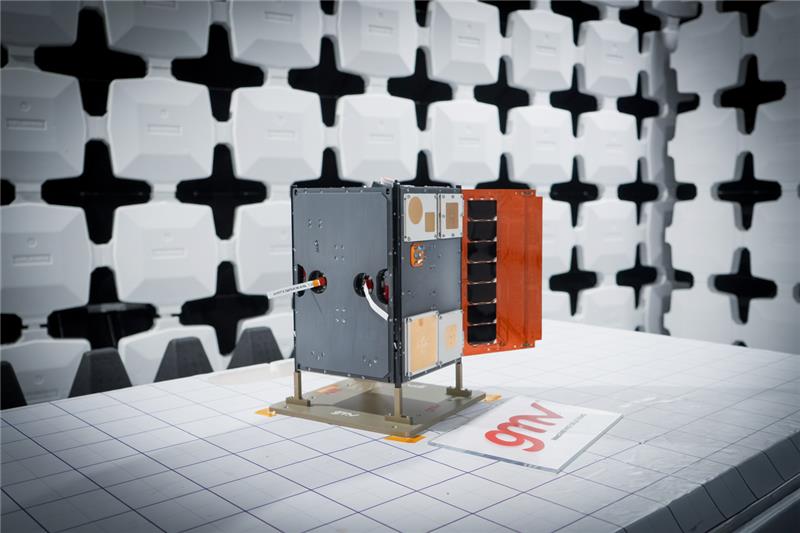
ESA has confirmed reception of the first navigation signal transmitted by the Celeste IOD-1 satellite, a 12U CubeSat developed by GMV and Alén Space under the European Space Agency’s Celeste In-Orbit Demonstrator program.
The signal was received at 10:38 CET on April 8, 2026, and verified by ESA teams at ESTEC as well as at GMV’s monitoring station in Lisbon.
The milestone marks successful commissioning of the spacecraft and opens the operational experimentation phase of a program designed to test whether a complementary low Earth orbit navigation layer can enhance Galileo’s accuracy, resilience, and security. Celeste IOD-1 and a second demonstrator, IOD-2, were launched March 28 aboard a Rocket Lab vehicle from Launch Complex 1 in Mahia, New Zealand. The two satellites — built by separate European consortia, with GMV leading one and Thales Alenia Space the other — separated from the launch vehicle approximately one hour after liftoff. LEOP and commissioning activities for IOD-1 were conducted by an integrated GMV and Alén Space team from the mission control center in Tres Cantos.
Operating at altitudes between 500 and 560 km, the demonstrators will validate precise autonomous orbit determination without ground infrastructure dependence and will test navigation signal performance in L- and S-bands from LEO. The program’s rationale is multi-orbit resilience: by integrating a LEO constellation alongside Galileo’s medium Earth orbit architecture, Celeste aims to reduce vulnerability to interference and expand the envelope of advanced PNT services available to European users.
The IOD phase will comprise eleven satellites plus one in-orbit spare across both consortia. GMV holds prime contractor responsibility for six of the demonstrator satellites, covering system definition and design, space and ground segments, user segment, and operations. The two initial demonstrators are focused on securing registered frequency allocations and signal testing through the end of 2025. Eight larger follow-on satellites are under development, with subsequent launches targeting 2027 and the eventual fielding of a full operational fleet.
GMV was selected by ESA in 2024 to lead one of the two parallel Celeste development contracts.