From IMU fundamentals to low-SWaP-C system design, experts explain how tightly integrated GNSS-INS is delivering resilient navigation when satellite signals are degraded, intermittent or denied.
While GNSS remains the backbone of positioning, its limitations can’t be ignored. GNSS signals are vulnerable to multipath interference, while spoofing and jamming attacks that render GNSS unreliable continue to grow in number and sophistication. Urban canyons, tunnels and indoor transitions also remain a challenge for GNSS and the users who require access to accurate positioning in these environments.
This reality, combined with the rise in autonomous solutions across various industries from agriculture to defense, makes closing the growing gaps in GNSS mission critical. Reliable, backup
solutions are a must. Inertial navigation systems (INS) are a natural complement, providing continuous, high-rate propagation through GNSS outages.
The push for autonomy has ushered in a new era of GNSS-INS integration, making this combined approach mainstream rather than exotic. Inside GNSS, along with Hexagon | NovAtel and Inertial Sense, explored this critical integration in a recent webinar. James Chan, business unit lead, INS, Aerospace & Defence Division, Hexagon, provided the system-level perspective, while Walt Johnson, founder and CTO of Inertial Sense, focused on low-SWaP-C tactical grade MEMS implementation.
IMU Fundamentals and the Cost–Accuracy Ladder
Chan gave us a look inside what makes up inertial measurement units (IMUs), the core of an INS. IMUs come in different options and grades, but all
leverage various sensors to measure an object’s movement and orientation. Accelerometers measure linear acceleration, while gyroscopes measure rotational acceleration. Both typically operate on three axes, giving the IMU six degrees of freedom (DoF).
Many IMUs now also include magnetometers to measure magnetic fields, which can be translated into a heading, Chan said, and barometers to measure atmospheric pressure, which can be translated into an altitude. IMUs that include a three axis magnetometer have 9 DoF, while those that also have a barometer achieve 10 DoF. Magnetometers typically require calibration to account for local interference and magnetic declination.
It’s important to note that every IMU has drift, Chan said, which leads to accumulating errors in the IMU data. These errors will continue to grow if there’s no external input to correct them. The drift rate is also dependent on sensor stability.
“Nearly all inertial navigation systems will run some kind of filter, usually an Extended Kalman Filter or EKF, and that’ll have the INS solution running and take in GNSS updates to help compensate for any errors in the IMU measurements,” Chan said. “In between updates, the inertial solution will bridge the gap and continue to offer position, velocity and attitude at times when GNSS isn’t available.”
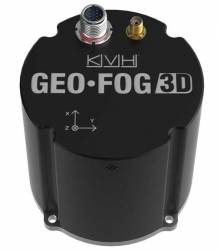
An IMU’s accuracy, Chan said, is driven by the gyroscope, with three main types available: Ring laser gyroscope (RLG), fiber optic (FOG) gyroscope and Microelectromechanical Systems (MEMS). The RLG, the oldest, features two counter-propogating lasers that travel within a closed space, using a system of mirrors to “effectively bounce those lasers.” When the system rotates, one beam travels a longer path than the other. The detector picks that up and calculates the rotation rate based on the time difference of when the two lasers arrive.
The newer FOGs also measure two beams of light, but do so by traveling around a closed fiber optic coil and measuring the difference of when the beams arrive back. Increasing the coil length changes the resolution on what a FOG can measure.
FOGs tend to be smaller and cheaper than RLGs, but typically aren’t as accurate, Chan said, though the technology continues to improve.
These days, most people use MEMS gyroscopes. There’s different types of MEMS for various applications, but all basically look at how a silicon structure behaves after some sort of force is applied. Compact MEMS gyroscopes have the lowest SWaP-C and can be found on anything from cell phones to UAS.
Regardless of type, IMUs come in different classification grades: consumer, industrial, tactical and navigation. Gyro in-run bias stability is how a gyroscope bias drifts over time during operation at a given temperature. It is also referred to as bias instability. The higher the value, the more unstable the bias drift will be, and the worse the results you’ll get.
Angular Random Walk (ARW) is another key metric, measuring the signal noise to indicate what the angular error could look like as it accumulates over time.
“These values are determined by doing an Allan Variance Plot, and it’s a critical metric for determining gyroscope accuracy,” Chan said. “Smaller values indicate the random noise associated with the signal will have less of an impact on your angular measurements.”
Quantum IMUs are also on the horizon, Chan said. These next generation navigation sensors will use atom interferometry to measure acceleration and rotation, measuring how lasers interact with cooled down atoms.
“These sensors can be nearly 1,000 times as accurate as standard MEMS sensors,” Chan said, “but it’s currently limited by a low output rate and a very high power draw with no real commercial products yet.”
From Satellite Fixes to Continuous Navigation
GNSS requires visibility of the sky, with accuracy dependent on the satellites’ track, Chan said, one of its limitations. Still, there is “no better system to provide an absolute position that has zero infrastructure requirements needed on the user side besides an antenna and receiver.” Tightly integrated GNSS-INS adds an important layer. GNSS is absolute but vulnerable and lower rate, while INS is relative, drifting but high-rate and immune to interference.
Chan provided a real-world example of how IMUs make navigation more resilient, showing a NovAtel receiver moving through downtown Calgary. GNSS was pulled in multiple directions, leading to an inaccurate trajectory. When the team incorporated an IMU into the solution and ran NovAtel SPAN software, there was a “remarkable improvement” in the positioning domain due to the relative accuracy of INS while also taking in the absolute accuracy of GNSS, which helps constrain error growth.
Of course, the ranges of IMUs that can be incorporated into these systems offer varying levels of performance at different price points. There’s a fit for every application, whether mid-grade or high-grade performance is required. Key performance metrics for integrated systems include position accuracy under nominal conditions and through outages; attitude; and robustness to shock and vibration in real platforms.
What customers are most interested in, Chan said, is position, velocity and attitude (PVA) requirements.
“Customers will look at whether an IMU will be able to deliver in this department first,” Chan said. “On NovAtel SPAN products, we break this apart by outage duration. Customers have an easy way to understand what performance they can expect.”
The next consideration is SWaP-C. Most want smaller IMUs that draw less power, Chan said. And as the technology matures, IMUs are naturally becoming smaller, lighter and more efficient.
Detailed technical requirements include bias, stability, ARW and dynamic range.
“The dynamic range for an accelerometer is measured in Gs, the gravitational unit,” Chan said. “This indicates the acceleration value the accelerometer is capable of handling and shouldn’t be confused with shock or survival ratings.”
Then there’s velocity random walk (VRW), similar to ARW, which is a “very good indicator of how noisy the signals will be when you do integrate them.”
There’s demand for accurate IMUs with small footprints and low weight that draw minimal power, have a wide dynamic range and a low ARW. The performance required is somewhere between industrial and tactical.
Delivering Tactical-Grade Performance in MEMS Form Factors
Inertial Sense is focused on democratizing tactical grade GNSS-INS navigation, Johnson said, developing low SWaP-C solutions for autonomous platforms and defense applications. The company’s mission is to make effective tactical grade navigation technology accessible for platforms that are constrained by size, weight and power.
“We deliver a multi-GNSS and MEMS IMU sensor fusion architecture that delivers tactical grade attitude, centimeter-level RTK positioning and modules that weigh less than one gram,” Johnson said. “Our systems emphasize low SWaP-C, high rate estimation and robust operation in GPS-denied environments.”
That technology is leveraged across a range of applications, including UAS, robotic systems, maritime and precision stabilization platforms. These days, Inertial Sense is seeing increased demand driven by emerging applications like loitering munitions, engagement systems, commercial autonomous
vehicles and humanoid robots. Such applications “require tactical grade navigation performance, but they also require mass market pricing.” Navigation grade or military grade IMUs that provide the highest performance typically cost $100,000 or more.
“The fundamental problem to the market today is tactical grade navigation systems are too expensive for large scale deployment,” Johnson said. “Our solution is to deliver industry leading navigation performance at a disruptive price performance point. This enables our customers to deploy navigation autonomy at whatever scale they require.”
The Inertial Sense product portfolio consists of compact IMX tactical grade IMUs and INS navigation modules, and the GPX series of multi-GNSS receivers. The receivers support several configurations, raw measurement output, centimeter-level positioning and dual antenna heading. Both product families are available in OEM surface modules and rugged, enclosed systems.
Cost optimization is a key differentiator for the IMX line, Johnson said. Inertial Sense focuses on keeping tactical grade sensors to between $5,000 and $25,000, targeting low cost hardware and sensors and selecting the optimal algorithms to deliver tactical rate performance on that hardware.
“Our systems are built using off-the- shelf components,” Johnson said, “but combined with proprietary design and calibration processes that enable us to create high precision performance.”
The navigation systems also run on single precision floating point unit microcontrollers; Inertial Sense doesn’t use double precision hardware.
“Part of what we do to maintain numerical stability is use a square root extended Kalman filter that uses UD factorization,” Johnson said. “And this approach enables stable estimation high rate updates and then efficient computation on low cost processors.”
To maintain accuracy during high dynamic motions, Inertial Sense implemented coning and sculling compensation. The algorithm prevents systematic integration of errors, such as attitude errors caused by oscillatory rotations between gyro samples and velocity errors caused by simultaneous rotation and linear acceleration. These techniques prevent motion and oscillation vibrations from degrading the tightly integrated solution.
Inertial Sense also offers a lightweight, multi-band RTK engine that’s optimized for low SWaP GNSS receivers and processors. A modular GNSS architecture makes it easy to integrate the IMUs with multiple receivers, including the u-blox F9 and X20. There are also plans to release firmware that supports integration with the Septentrio mosaic-G5.
Johnson shared real-world examples of the IMU in use, with one demonstrating IMX in ground vehicle dead reckoning mode. The vehicle overcame a 105 second GNSS outage in a parking structure, driving about 350 meters and experiencing about 6% drift. In ground vehicle mode drift is “more of a function of distance traveled than time.”
Other tests compared IMX against established systems like NovAtel SPAN, with the IMUs achieving comparable results.
Roadmap: Pushing GNSS-INS Further for Autonomy
The latest IMX model, the IMX-6, is scheduled for release this year and represents a 30% improvement in attitude and accuracy over the IMX-5. It will support a 500 Hz output rate and will feature enhanced roll and pitch accuracy, improved heading accuracy, reduced gyro bias stability, lower ARW and lower acceleration bias instability. It also has an increased sensing range and improved sensory redundancy.
IMX-6 will be able to handle higher acceleration ranges, with proprietary processes allowing high volume precision calibration across temperature.
As vibration performance is critical, the sensor is undergoing shock and vibration testing as well as dynamic frequency response characterization.
“Each IMX is fully calibrated during manufacturing across a temperature range of negative 40 to 85 degrees Celsius,” Johnson said. “This includes bias calibration, cross axis alignment and scale factor calibration.”
There are also plans to add temperature compensation for scale factor modeling.
In-field calibration procedures and guidance are also available for IMX sensors. Customers with smaller devices can place them on a precision level surface and, depending on the level of alignment needed, calibrate in a few seconds.
“It may be that they tip it on multiple sides, or it may be that they just level it in the normal operating direction, and then they inform the system that it needs to be calibrated in what mode,” Johnson said. “There’s different modes to put it in, and it doesn’t require much space at all.”
Customers with large vehicles can use GPS to similarly inform the system of sensor alignment. Inertial Sense can guide customers through both processes.
Enhancements to the IMX-6 allow for easier drop-in upgrades, enhanced dynamic behavior, more predictable performance across temperature, broader GNSS ecosystem coverage and smoother field maintenance for end users.
Real-World Programs and What Buyers Should Ask
IMX sensors are making an impact across various industries. Customer case studies include:
• A global satellite communication provider. This ongoing customer needed an INS system that could deliver a fraction of a degree of orientation accuracy for satellite tracking on moving vessels. Existing solutions were too expensive for the market they were targeting. Inertial Sense delivered a solution that integrated tactical inertial grade navigation with low SWaP GNSS receivers. They also adapted manufacturing process to support the customer’s delivery schedule.
• A defense technology company. The unmanned systems developer needed a lower ARW and bias instability than the IMX-5 could provide. In response, Inertial Sense collaborated with the customer to develop the IMX-6, which meets both their performance and SWaP-C requirements. This opened up other opportunities with the customer.
• An autonomous landscaping developer. This customer required high precision navigation compatible with the commercial mower equipment market. Inertial Sense worked closely with the engineering team to integrate an IMX into their autonomous platform.
With every case study, peformance for low SWaP applications was a key consideration. Inertial Sense was able to deliver tactical-grade metrics without navigation-grade prices. The company also offers integration, support and environmental robustness.
Before investing in a GNSS-INS solution, it’s important to know what to ask. Manufacturer data sheets differ, making it critical to understand the most important metrics and how they could impact your solution. Key areas to consider include:
• Performance
• Real-world testing results
• Outage behavior
• Calibration
• The product roadmap and expected future updates
GNSS-INS as Autonomy Infrastructure
Autonomy needs more than GNSS. To meet that need, GNSS-INS integration has evolved from niche, high-end avionics to a foundational technology for mainstream autonomous systems. Advances in MEMS IMUs, fusion algorithms and integration ecosystems are making tactical-grade performance accessible at scale.
Visit insidegnss.com to access the webinar, data sheets and white papers from Hexagon | NovAtel and Inertial Sense.