The U.S. has fallen behind in both space-based and APNT. Now is the time to change that with new PNT policy and stronger governance.
Since 2004, the primary goal of America’s national PNT policy and governance structure has been to maintain United States leadership in space-based positioning, navigation and timing (PNT). While GPS remains an outstanding system, it has been surpassed in many ways by Europe’s Galileo and China’s BeiDou.
Perhaps more significantly, while China, Russia and other nations have or are building complementary and backup systems for space-based PNT, the U.S. has no deployed capability or plans for any. This, despite a presidential mandate for such a system that stood from 2004 to 2021, and senior leaders in the current administration citing the need.
When asked why the nation has fallen behind in both space-based and alternative PNT, many experts often give a one word answer: governance.
Governance is often defined as the process by which leaders make decisions. In the U.S., the current process for PNT was established in 2004 by President George W. Bush in National Security Presidential Directive 4. It was later slightly updated in the waning days of the first Trump administration by Space Policy Directive 7 (SPD 7), issued January 15, 2021.
America’s PNT governance structure is complicated. One in which responsibility is shared and authority is diffuse.
A Fragmented System
Leadership of PNT issues is assigned to two departments: The Department of Defense/War (DOD/W) for military uses and users and The Department of Transportation (DOT) for civil users.
Each department has its own internal governance processes, its own priorities, and its own bureaucratic machinery.
Inside DOT: Many Duties, Lots of Collaboration
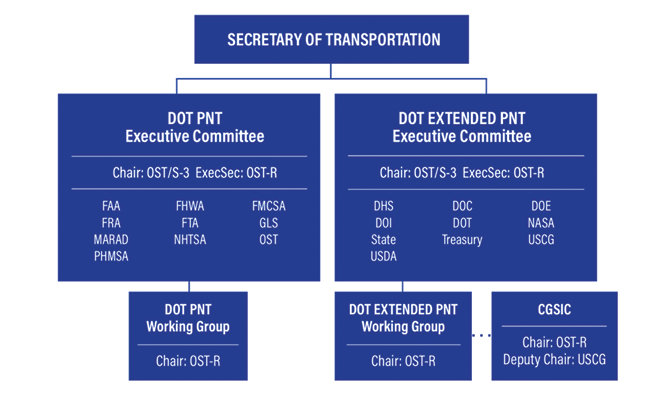
The DOT lead for PNT is the Assistant Secretary for Research and Technology (OST-R). But PNT is only one of many responsibilities, which also include spectrum management and overseeing the Advanced Research Projects Agency, the Bureau of Transportation Statistics, the Highly Automated Systems Safety Center of Excellence, the Intelligent Transportation Systems Joint Program Office, the Office of Research, Development & Technology, the Transportation Safety Institute, the Volpe National Transportation Center, and the Strengthening Mobility and Revolutionizing Transportation (SMART) grant program.
For PNT issues, OST-R coordinates 10 internal DOT organizations and a group of 10 organizations outside DOT. Together, these groups advise the Deputy Secretary and Secretary of Transportation.
Inside DOD/W: A Heavyweight Process with Lots of Players
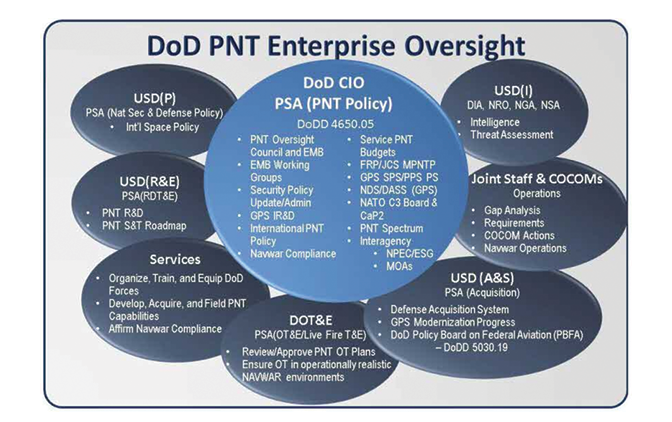
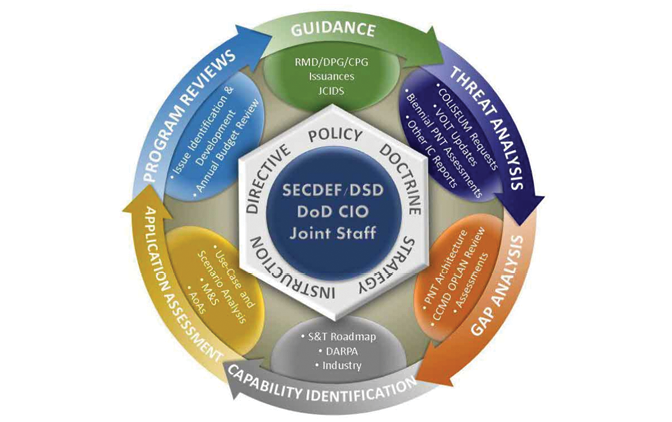
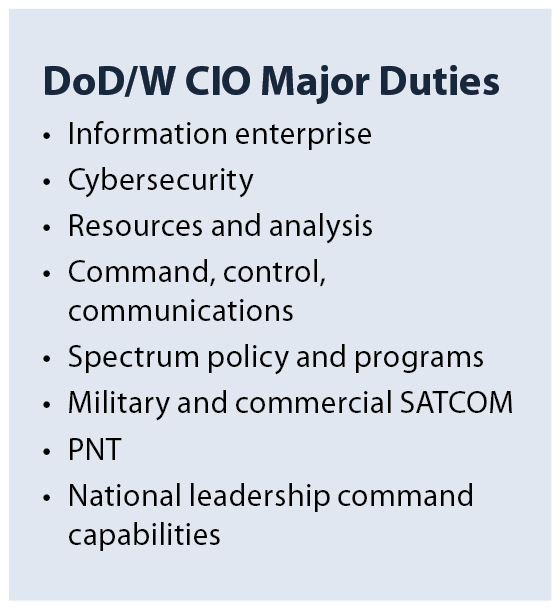
On the defense side, the Chief Information Officer (CIO) is the Secretary’s principal staff assistant for PNT. But again, PNT is only one of many duties—others include information technology, cybersecurity, spectrum policy, communications, command and control, and SATCOM.
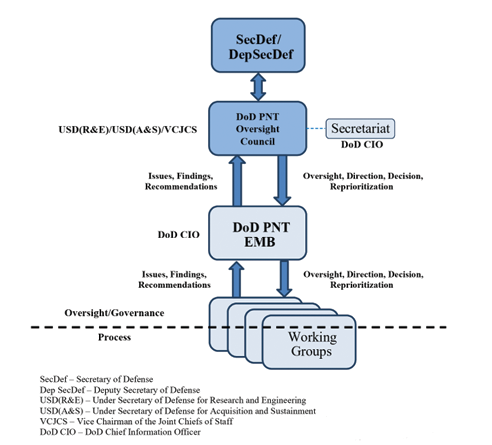
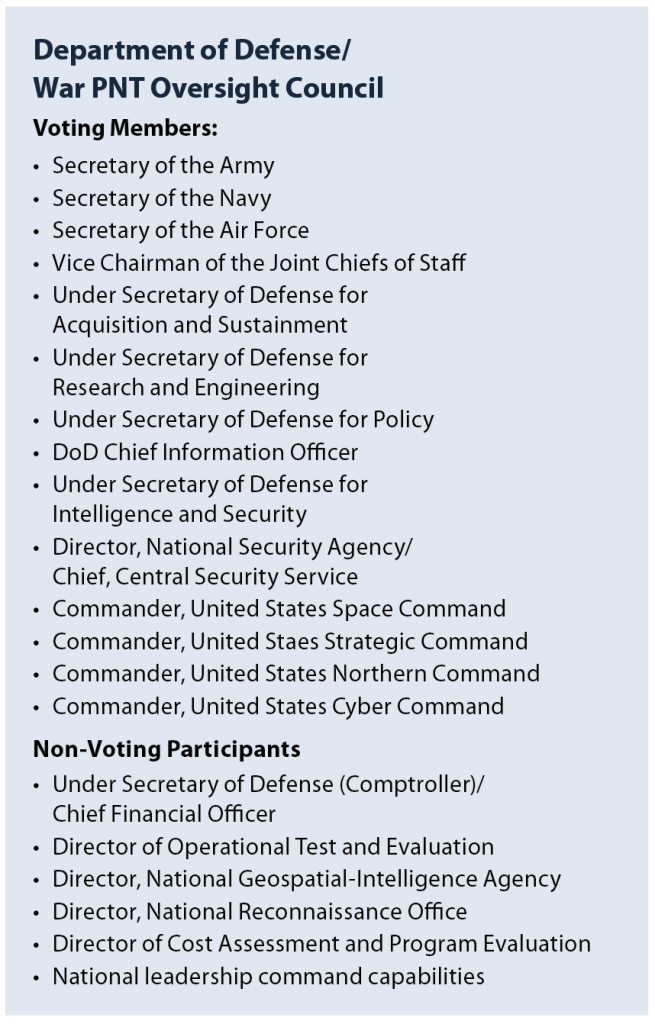
The CIO follows an iterative process that feeds into the DoD PNT Oversight Council, a body of 19 senior leaders—service secretaries, combatant commanders, undersecretaries, and intelligence chiefs. Very senior, very busy people who lead large and important organizations.
All must work together to advise the Deputy Secretary and Secretary of Defense.
When Issues Cross Departments: The EXCOM
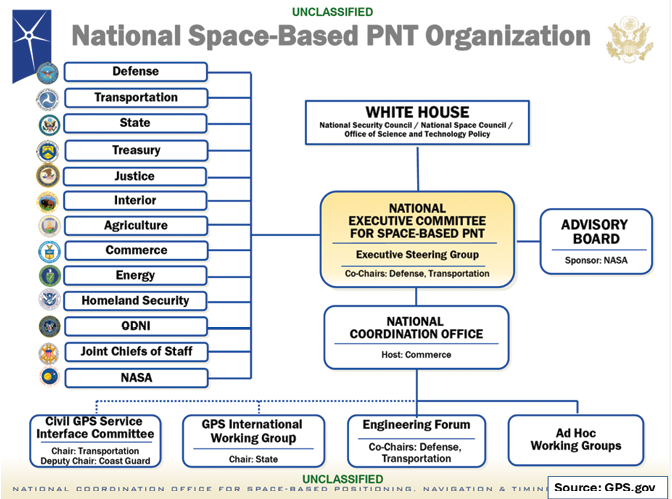
For national PNT issues that fall outside the authority of either DOT or DoD/W, governance shifts to the National Space Based PNT Executive Committee (EXCOM), co-led by the deputy secretaries of Transportation and Defense/War.
SPD-7 tasks the EXCOM to “…make recommendations on sustainment, modernization, and policy matters regarding United States space-based PNT services to its member agencies, and to the President, through the Assistant to the President for National Security Affairs, or the Executive Secretary of the National Space Council, as appropriate.”
Not visible in the formal process is the Office of Management and Budget (OMB). Yet, OMB is arguably the most important and powerful component of the executive branch. The office drives budgets, oversees the President’s Management Agenda, and adjudicates cross-department issues and priorities. Without OMB support, department initiatives die on the vine.
The EXCOM meets once or twice a year and serves primarily as a coordinating body. Despite the many people involved, or perhaps because of it, the United States has:
• Lost its place as the leader in space-based PNT, and
• Failed to safeguard national and economic security with long called for alternative PNT capabilities
What About Leadership?
Bureaucracy is inherent in government. Strong leadership can often cut through it—especially in times of crisis—and overcome obstacles that stall progress.
Leadership, in fact, is an essential element of good governance. It is the energy that powers structures, processes and institutions. But governance structures matter as well. They can nurture and enable leadership, or they can constrain and frustrate it.
If no crisis demands action and authorities and responsibilities are unclear, initiatives become vulnerable to criticism or outright veto from those wary of change or protective of their organizational “lane.”
Too many stakeholders can make collaboration unwieldy and give de facto veto power to individuals or groups who should not have it. And without a clear mandate from the top to achieve specific goals, even capable and determined leaders can find themselves blocked at every turn by an unwieldy governance structure and process.
Time for a Reset
Disruptions to GPS and other GNSS signals are increasing daily and are being seen more frequently in the homeland. Protecting the satellites, signals and their users is a national security and economic imperative.
America has an abundance of technical expertise and commercially avail-able PNT products and services that can enable it to regain world leadership while guarding its national and economic security.
It is time to reset our PNT governance and put these advantages to use.
But this effort can’t be one of just “rearranging the deck chairs on the Titanic.” We need a whole new ship.
America’s new PNT policy and governance must:
• Be about more than space. The need for one or more widely available backup and complementary sources of PNT for GPS in America is widely accepted. In a January 2021 report, the DOT found that combining signals from space with terrestrial broadcast and timing over fiber would constitute a core national resilient PNT architecture. That could be a great starting point.
• Identify and empower a “trail boss” or “first among equals.” Someone responsible for ensuring policies and plans are executed, timelines are met, and those responsible for action are held to account. Not a “czar,” but a champion tasked with bringing key actors and stakeholders together, developing a national plan, then ensuring it is executed.
• Establish specific goals and requirements for national PNT resilience. An updated policy and governance document doesn’t necessarily need to state accuracy, integrity, availability, and continuity requirements. But it should describe a resilient end state and draw the line between what utility-level services America’s national PNT architecture will provide, and what higher demand users must source for themselves. The core national resilient PNT architecture must be a backbone that other PNT systems and providers can leverage and build upon.
• A timeline to achieve the goals. For over two decades, national PNT policy has listed a variety of general and specific goals. None have had associated timelines and few have been achieved. A minimal resilient national PNT architecture of space, terrestrial broadcast, and fiber—the “resilient triad”—could be easily and quickly implemented. Mature technologies exist and can be available as products or performance-based service contracts. A target of five years would not be unreasonable for terrestrial components.
• Include OMB as an essential player. While SPD-7, and perhaps other national policy documents, discuss recommendations being submitted to the president, as a practical matter, that rarely happens, if ever. Instead, recommendations go to his personal management and budget staff—OMB. Unless they are on board, nothing happens.
Today’s PNT policy was published in the last few days of the first Trump administration. Its governance structure and processes are nearly identical to those used by the previous two administrations. In the five years since SPD-7 was published, the risk to the nation from over-dependence on GPS has increased significantly. It is time for this administration to break from its predecessors, forge a new path, and make America safer.