After four years of Army and Marine Corps experiments, DARPA says its RACER autonomy stack is ready to move into DoD and commercial use, enabling off-road ground vehicles to operate at speed in complex terrain without GPS or detailed maps.
Launched in 2021, Robotic Autonomy in Complex Environments with Resiliency (RACER) was conceived not as a single robotic platform but as an autonomy “stack”—a collection of algorithms, datasets and neural network models that can be ported to multiple vehicles equipped with appropriate sensors. According to DARPA, that stack now allows users to “apply the RACER stack to any vehicle … turning it into an autonomous machine capable of operating in challenging off-road environments, independent of GPS or pre-mapped routes, and at mission-relevant speeds.”
From Grand Challenge to GPS-independent ground autonomy
DARPA casts RACER as an heir to its 2004–2005 Grand Challenge, which helped kick-start the modern era of autonomous vehicles. Two decades later, the focus has shifted from proving that a single vehicle can complete a desert course to fielding a reusable autonomy layer that can be adapted quickly to new platforms and operational environments.
“RACER isn’t just about replicating existing military capabilities,” RACER program manager Stuart Young said in the agency’s announcement. “It’s about fundamentally reimagining how missions are executed.”
For the PNT community, the notable point is that RACER explicitly assumes unreliable or unavailable GPS. DARPA’s description emphasizes that the stack is intended to operate “off the grid,” with reduced reliance on GPS and pre-programmed paths, allowing robotic systems to handle missions such as reconnaissance and breaching at standoff distance from friendly forces.
Army use cases: breaching and long-range reconnaissance
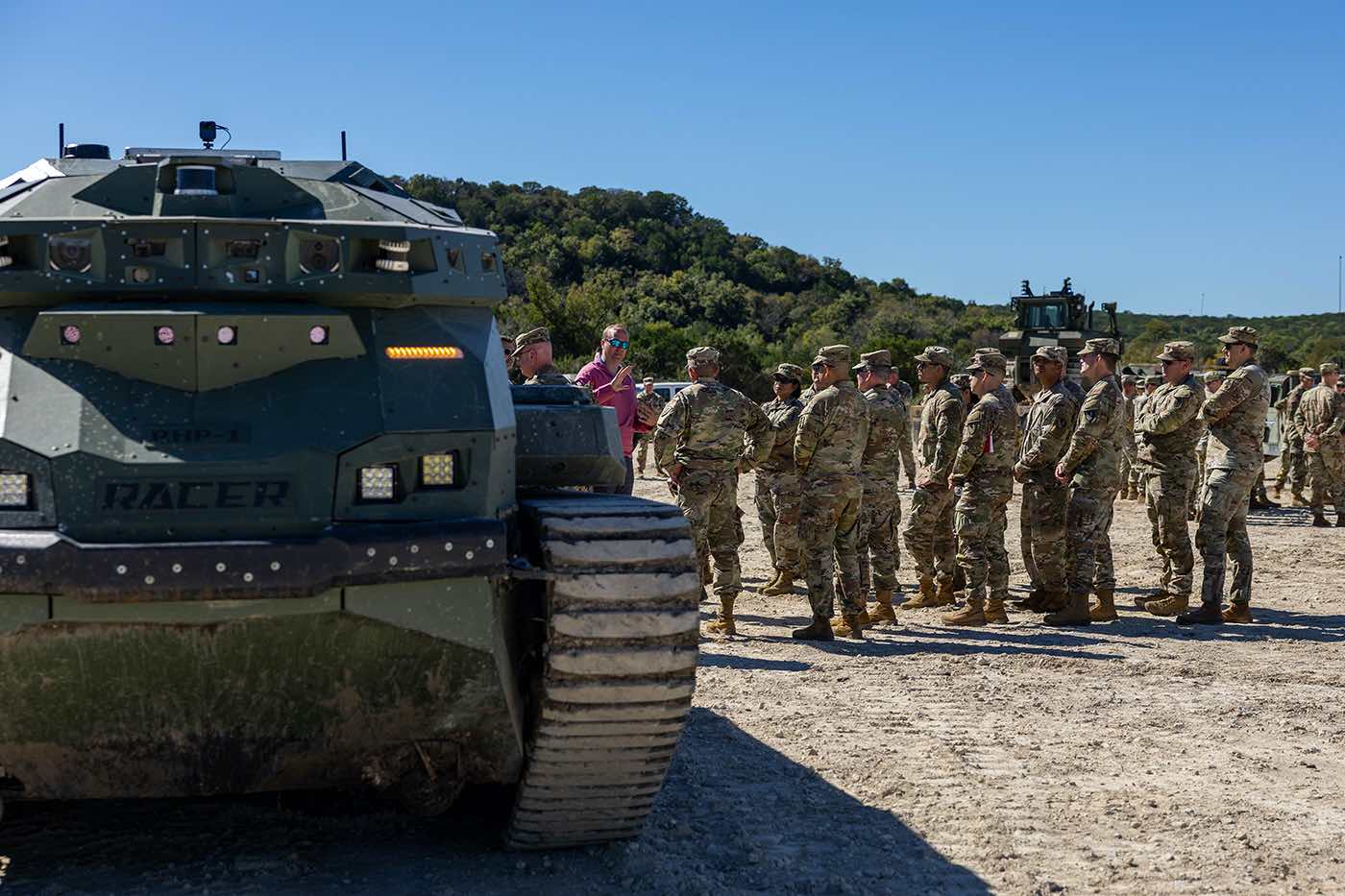
RACER’s final phase centered on operationally realistic scenarios with Army units. In October 2025, the program partnered with the Army’s III Armored Corps 36th Engineer Brigade during a combat breaching demonstration at Fort Hood, Texas, under the Machine Assisted Rugged Soldier effort. Using the RACER Heavy Platform—a Carnegie Robotics system built on a Textron M5 chassis—the Army paired the robotic vehicle with an M58 mine-clearing line charge to autonomously open a lane through a minefield.
DARPA highlighted that event as a proof point for using heavy uncrewed platforms in high-risk tasks where GPS may be degraded or denied and where keeping human crews farther from the breach is a priority.
In November 2025, soldiers from the 11th Armored Cavalry Regiment employed RACER-equipped Polaris RZR–based “RACER Fleet Vehicles” as part of an opposition force during a live force-on-force rotation at the National Training Center, Fort Irwin, California. With integrated ISR payloads, those platforms were tasked to conduct autonomous long-range reconnaissance—traditionally a mission for manned scout teams—again with reduced reliance on GPS and no detailed pre-mapping of the route.
“By decreasing reliance on GPS and pre-programmed paths, RACER ensures warfighters can deploy autonomous assets in any environment, even when operating off the grid,” Young said. “Instead of human scouts going 12 or 15 km into enemy territory, that dangerous work can be handled by a robot while humans are safe, and the risk is minimized.”
Perception and fast adaptation as “soft” alternative PNT
DARPA describes RACER’s perception architecture as the program’s most significant technical advance. Earlier autonomous ground systems often needed weeks of retraining when moved to a new environment. RACER, by contrast, is said to adapt a new model in roughly a day, which DARPA calls “invaluable for warfighters who need to deploy robotic assets rapidly to unfamiliar terrains.”
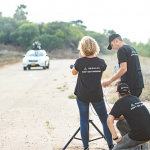
The agency likens the behavior to a human driver with “a priori insight” about how roads normally behave: the autonomy stack predicts what lies ahead based on prior experience and sensor evidence, then adjusts its speed and path when cues—such as an oddly parked vehicle or construction cones—indicate elevated uncertainty. That predictive capability allows higher speeds and safer operation in unstructured terrain, without the crutch of detailed maps or continuous GPS.
While RACER does not introduce a new radio-frequency PNT source, it effectively functions as a local, perception-driven navigation solution—a form of “soft” alternative navigation that depends on machine-learned terrain understanding rather than external timing or ranging. For PNT practitioners tracking how DoD plans to fight through GPS disruption, RACER sits alongside inertial, visual-odometry, and terrain-referenced navigation efforts as part of a broader shift toward GPS-independent autonomy.
DARPA’s final RACER experiment at Fort Irwin, California, was used to validate this perception architecture and its rapid retraining process, demonstrating that models could be adapted quickly to new terrain conditions while maintaining autonomous mobility.
Transition paths and dual-use autonomy
With the experimentation campaign ending, DARPA is now emphasizing transition to both military programs and commercial sectors such as agriculture, construction, mining and off-road logistics, where vehicles face similar perception and navigation challenges. Multiple companies have spun out of RACER, including Field AI and Overland AI, which trace their origins to NASA Jet Propulsion Laboratory and University of Washington research respectively.
“Now that the RACER program is ending, there is a lot of commercial opportunity for private equity,” Young said. “It’s time for both military users and private investors to recognize the transformative potential of RACER and embrace a future where autonomous systems are not just a possibility, but a reliable and integral part of our world.”
RACER is another signal that DoD is planning for operations where GPS cannot be assumed. Even without a new RF PNT layer, programs like RACER are pushing the services toward autonomy stacks that treat GNSS as one input among many—and that are explicitly designed to keep vehicles moving when that input disappears.