Satellite-based augmentation systems (SBAS) such as EGNOS, WAAS and MSAS have been quietly underpinning safety-critical navigation for decades, delivering correction and integrity data that enable more accurate and dependable GNSS positioning.
As SBAS services continue to evolve and new satellite platforms emerge, payload designers must integrate augmentation functionality within ever tighter constraints on mass, volume, power and interface compatibility.
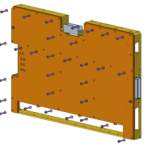
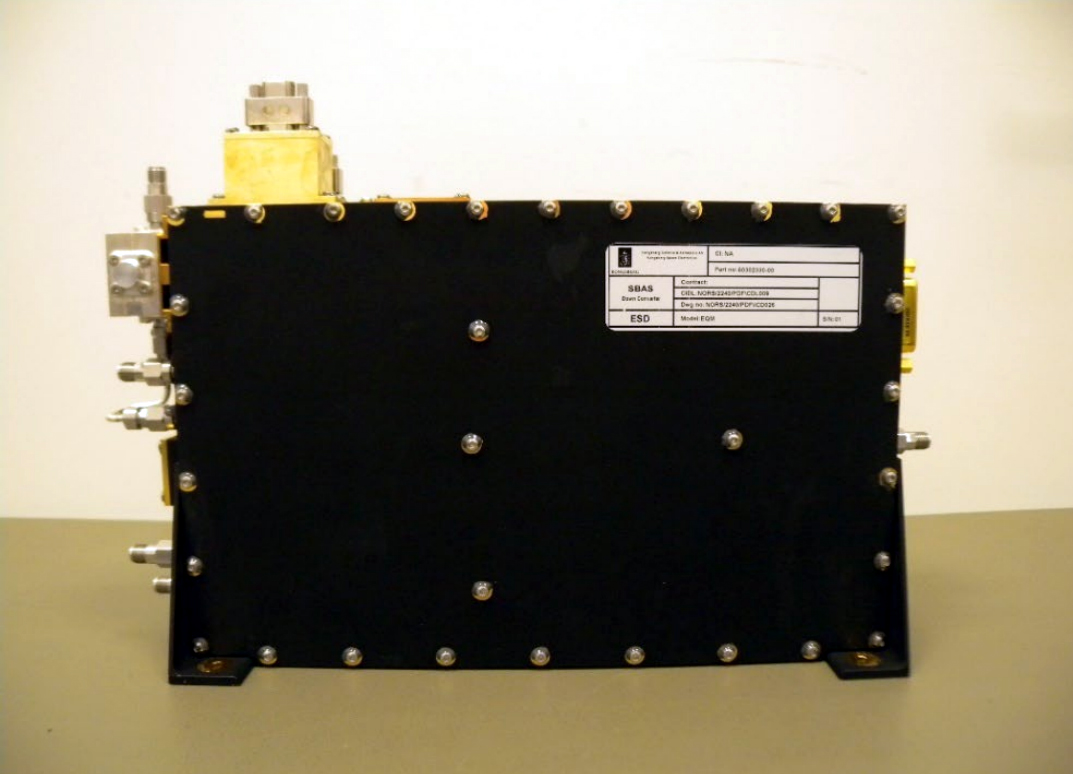
Kongsberg Space Electronics has developed a compact, versatile SBAS onboard down converter with support from the European Space Agency (ESA). “An SBAS onboard down converter receives correction and integrity signals uplinked from ground stations to the satellite in C-band, converts them to the navigation L-band, amplifies the signal, and broadcasts it to users over a wide service area.”
Although this function is well proven, many existing designs offer limited adaptability when confronted with new frequency plans, platform interfaces or multi-channel requirements. The Kongsberg project focused on the design, and development of an engineering qualification model (EQM) suitable for SBAS payloads on geostationary satellites, with potential applicability to future medium Earth orbit (MEO) platforms.
Addressing a real need
The project results were presented at a recent ESA-hosted event by Kongsberg Product Responsible and Radio Frequency Design Lead Angelica Viola Marini, and R&D Project Manager Grunde Joheim. Their new solution employs a highly integrated yet modular architecture that enables efficient SBAS down-conversion while maintaining design flexibility. It supports both single-channel (L1) and dual-channel (L5 and E5b) SBAS configurations, with adaptable uplink and downlink frequency plans.
Modular building blocks, including C-to-L band converter hybrids, SAW filter modules, flexible frequency generation, and configurable DC/DC power conversion, allow the design to be tailored to different satellite buses without extensive redesign.
Technical performance was demonstrated through a comprehensive qualification campaign, including vibration, shock, thermal-vacuum, EMC and electrical testing. Results showed stable gain and output power over temperature, low noise figure, strong spurious suppression and good return loss, confirming suitability for operational SBAS payloads.
Importantly, the compact unit achieves this performance with a mass below 1.6 kg and a reduced envelope, directly supporting more efficient payload integration. For end users of SBAS, ranging from aviation to maritime and emerging autonomous applications, this work delivers space segment robustness, which directly translates into service availability and integrity on the ground.
The project ‘Compact versatile SBAS down converter’, was funded under ESA’s NAVISP program, aimed at strengthening the competitiveness of the European positioning, navigation and timing (PNT) industry.