The European Space Agency (ESA)-funded project ‘Lithium niobate photonic integrated circuit based high-speed, low voltage modulators for microwave photonics’ has demonstrated a new class of ultra-high-performance optical modulators with direct relevance to future positioning, navigation, and timing (PNT) systems.
The project was led by Belgian non-profit IMEC, working with partner Ghent University (UGent). Final results of the project were presented at a recent ESA-hosted event by Bart Kuyken, Tom Vanackere, and Arno Moerman of IMEC and UGent.
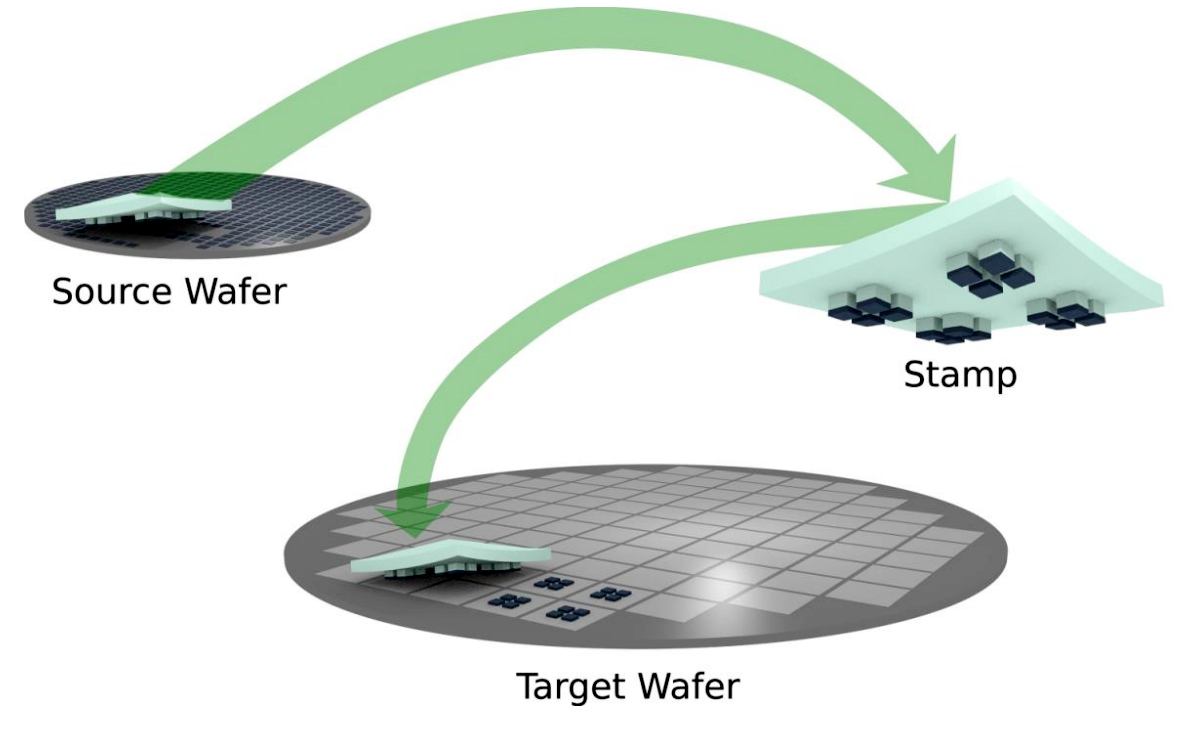
The team developed next-generation electro-optic modulators by integrating lithium niobate (LN) onto a silicon nitride photonics platform using micro-transfer printing. This back-end integration approach enables compatibility with wafer-scale complementary metal-oxide-semiconductor (CMOS) fabrication while targeting modulation bandwidths beyond 100 GHz.
The relevance to PNT of the new modulator type lies in its role as a critical upstream enabling technology. Future GNSS, LEO-PNT, and timing distribution systems increasingly rely on photonic techniques for the generation, modulation, and ultra-stable distribution of RF and timing signals. High-speed LN modulators enable precise optical control of microwave carriers, which is essential for low-jitter clocks, RF-over-fiber distribution, inter-satellite timing links, and next-generation navigation payloads.
From photonic platform to ultra-fast modulation
The project began with a detailed analysis of LN for PNT-related applications, including optical clocks, local oscillator distribution, radio-over-fiber links, and photonic-assisted sampling. The modulators were integrated on IMEC’s iSiPP200 silicon photonics platform, which supports operation at both 1310 nm and 1550 nm and includes high-speed germanium photodetectors.
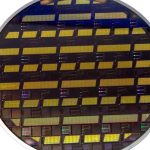
Using micro-transfer printing, pre-patterned LN coupons and waveguides were accurately positioned on silicon photonic wafers with sub-micron alignment. This enabled tightly confined optical modes and efficient electro-optic interaction. A 7-mm-long hybrid LN-on-silicon Mach-Zehnder modulator was fabricated and characterized.
Measurements demonstrated strong performance, including a total insertion loss of about 1.1 dB, a modulation efficiency VπL of approximately 2.5 V·cm, and high extinction ratios exceeding 15 dB. High-speed operation was validated through electrical and opto-electrical testing and eye-diagram generation. System-level demonstrations showed the feasibility of high-efficiency optical links reaching data rates up to 320 Gbit/s with energy consumption as low as 4 pJ per bit.
The project has been presented at major photonics conferences and generated an accepted paper in Nature Photonics. By enabling compact, low-power, ultra-high-frequency photonic signal processing, the technology provides a foundational building block for future GNSS, LEO-PNT, and optical timing architectures where microwave precision and photonic integration must converge. The project was funded under ESA’s NAVISP Element 1 program.