

In an increasingly interconnected world, the reliability of global navigation satellite system (GNSS) services supports critical infrastructure, from aviation and maritime navigation to telecommunications, agriculture and financial systems.
As threats to GNSS signals—ranging from unintentional interference to deliberate jamming—continue to grow, building resilience into the system is no longer optional. While software-based defenses and downstream technologies get much of the attention, the first line of defense is often overlooked: the GNSS antenna.
THE ANTENNA: THE UNSUNG HERO OF GNSS RESILIENCE
GNSS antennas are the gateway to space-based navigation data. Every signal that fuels precision positioning, navigation and timing (PNT) solutions starts its journey through an antenna. As such, the antenna’s design, performance and configuration play a pivotal role in ensuring the integrity, continuity and availability of GNSS services.
Modern threats to GNSS aren’t just about accidental interference—they’re also about intentional jamming. Jamming devices can easily block GNSS signals that are already weak when they reach Earth. In these hostile environments, a robust antenna is the first—and often the most effective—layer of defense.
ENVIRONMENTAL AND MECHANICAL RESILIENCE
A resilient GNSS system also requires antennas that can withstand harsh
environments—extreme temperatures, physical shock, vibrations and electromagnetic threats. Ruggedized enclosures, weatherproofing and electromagnetic shielding ensure continuous operation in field conditions, whether on a remote oil rig, a military convoy or a satellite uplink station.

FILTERING OUT THE NOISE: INTERFERENCE REJECTION AT THE FRONT END
Advanced GNSS antennas are equipped with high-quality filters that reject out-of-band interference before it reaches the antenna low noise amplifier (LNA) and GNSS receiver. With the proliferation of adjacent-band systems like 5G, interference at the antenna level is becoming more frequent. A high-performance antenna can significantly improve system resilience by ensuring only the desired GNSS frequencies are processed, reducing the noise floor and increasing the signal-to-noise ratio (SNR).
Calian’s XF+ technology provide 80 dB of out-of-band mitigation (from 400-2500 MHz). The + feature splits the signal amplification paths into two independent frequency channels (upper [L1] and lower [L2] bands). The result is that XF+ will enable the antenna to continue to provide the attached receiver with a usable signal if either L1 band or L2 is jammed but not both.
MULTI-BAND, MULTI-FREQUENCY CAPABILITY: DIVERSITY AS A DEFENSE
Resilient GNSS systems increasingly rely on multi-frequency and multi-constellation capabilities. Antennas that support GPS, Galileo, BeiDou and regional systems across multiple frequencies (L1, L2, L5, etc.) ensure receivers have more signals to estimate PNT.
A jamming attack may target the GPS/Galileo L1/E1 signals, but if the antenna is also receiving GPS L2 and Galileo E5b signals, the XF+ antenna will provide a usable signal to the receiver. Thus, an XF+ enabled multi-band GNSS antenna is an integral component in a resilient GNSS system.
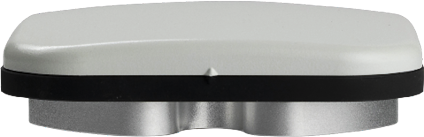
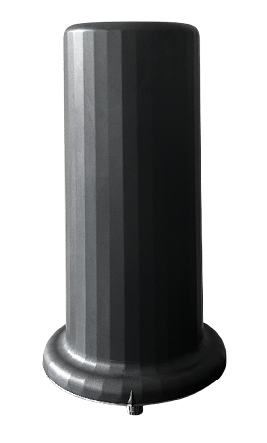
LOW ELEVATION ANGLE NULLING ANTENNA
Low elevation angle nulling antennas (LEANA) offer significant benefits where interference and jamming signals are transmitted from the ground up to an elevation angle of approximately 15 degrees. By suppressing or “nulling” signals coming from low elevation angles, LEANA antennas attenuate the jamming signal by approximately 15 to 20 dB and prevent the antenna’s LNA from saturating. As a result, systems using LEANA antennas can continue to function when the jammer is 10 times closer to the LEANA than a standard GNSS antenna. (See Calian TW3742AJ and AJ977XF+ LEANA products.)
DIRECTIONAL BEAMFORMING AND NULL STEERING
State-of-the-art GNSS antennas now include controlled reception pattern antennas (CRPAs), which use beamforming techniques to suppress interference from jamming sources. By electronically steering nulls toward interference sources, CRPAs provide a powerful mechanism for real-time resilience and situational awareness in areas with active jamming or interference.
This technology, once reserved for military applications, is now available for commercial and critical infrastructure use. Paired with sophisticated GNSS receivers, CRPA antennas give operators an agile, intelligent front-end defense against in-band interference and jamming signals. Calian’s CR8894SXF+ family of products are designed to mitigate three jamming signals in both the upper and lower band for a total of six. Calian’s CRPA technology provides mitigation ranging from 20 dB (wide band chirp jammer and enables PNT estimation up to 10 times closer to the jammer) to 40 dB (continuous wave jammer and enables PNT estimation up to 100 times closer to the jammer).
INVESTING IN THE RIGHT RESILIENT GNSS ANTENNA PAYS DIVIDENDS
Choosing a high-quality GNSS antenna is not a minor detail—it’s a strategic decision that can make or break a mission-critical system. For operators designing resilient PNT solutions, investing in the right antenna isn’t just smart—it’s essential. Contact Calian GNSS for more information at in*******@****an.com.