With funding from the European Space Agency, Swiss R&D company Saphyrion Communication Technologies has developed Detectrion, a GNSS RF recording and playback system designed specifically for interference detection.
The system functions autonomously, identifying interference events in real time and recording a predefined set of GNSS bands when such events occur.
Notably, Detectrion is the first standalone product to combine and integrate all of these capabilities in a single solution. When interference is detected, Detectrion captures the digitized multi-band GNSS RF stream. This allows for further analysis, supports event detection, and makes it possible to replay all relevant GNSS bands. The playback can begin at any arbitrary point within the recorded file, which is especially useful for examining how a system responds to real-life events.
At a recent event hosted by ESA, Angelo Consoli, General Manager Space Program, and Yuval bar Yossef, Director Business Development, both of Saphyrion, presented the final results of the project.
Detectrion was designed to demonstrate a new kind of real-time spectrum analyzer architecture. Unlike traditional designs, it relies on a parallel filter framework and shifts key processing tasks from hardware to software. This approach significantly improves flexibility and reconfigurability.
Clear goal in mind
“The need for an instrument like Detectrion has become increasingly urgent,” Consoli said. “GNSS interference is on the rise, but the tools available to monitor it remain expensive and difficult to deploy.” In contrast, jamming devices are becoming cheaper and more widespread. New technologies like 5G, satellite communications, and megaconstellations require affordable and scalable spectrum monitoring, and these applications demand solutions that are rugged, modular, and cost-effective.
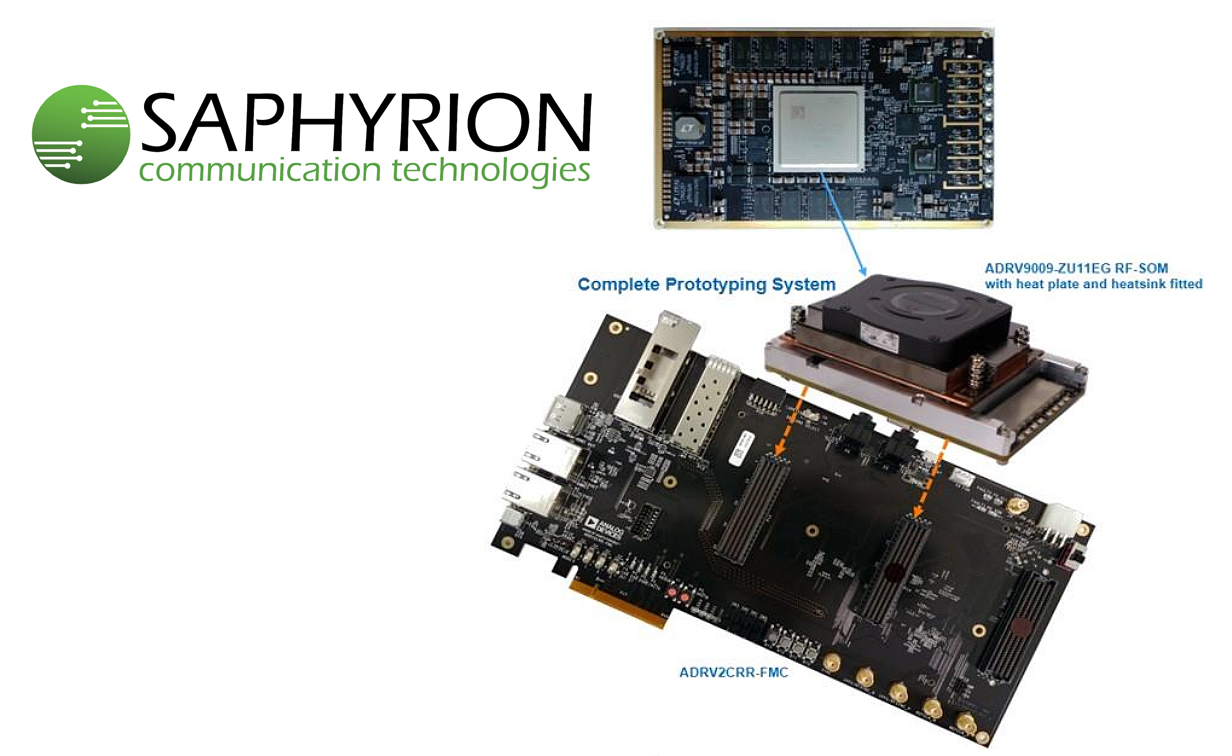
Detectrion supports 200 MHz bandwidth per channel using a parallel filter architecture. Saphyrion leveraged the ADRV9009 chip, designed for 5G applications, to achieve a low-cost, high-performance solution. Detectrion features dual transmitters and receivers, integrated synthesizers, multichip phase synchronization, and a JESD204B datapath interface. With a tuning range from 75 MHz to 6000 MHz, it suited the needs of this spectrum analyzer well, despite originally being intended for a different market.
Consoli said future plans include adapting Detectrion for other frequency bands, creating a compact version for space use, and offering its core technology under license. The project was co-funded under NAVISP Element 2, supporting European innovation in positioning, navigation, and timing technologies.