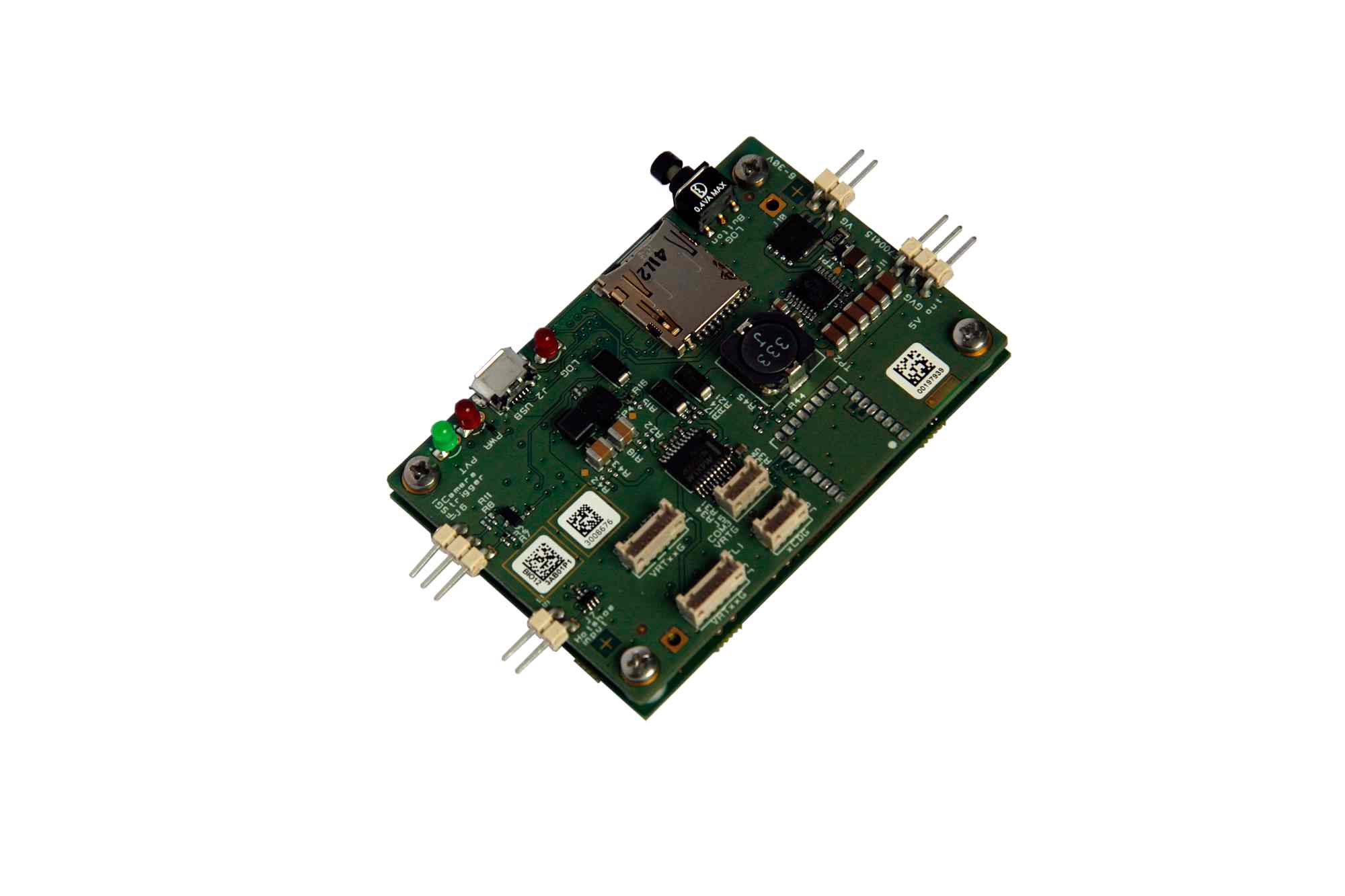
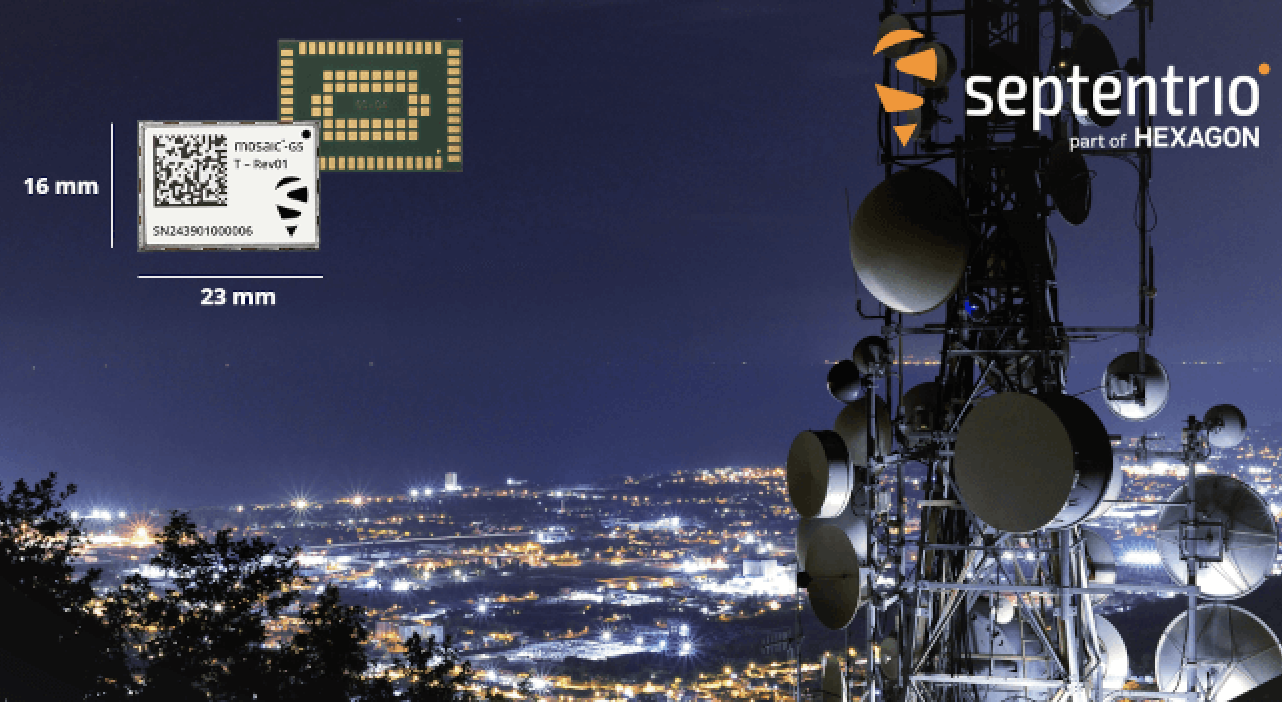
The new G5 receiver from Septentrio optimizes resilience, efficiency and capability without any compromises at the performance level.
GNSS has never enjoyed pristine signal conditions—ionospheric and tropospheric scintillation, urban multipath, canopy attenuation, receiver self-interference, and both unintentional and intentional jamming are persistent realities. What has changed is scale, intent and consequence. Accuracy remains essential, but the defining metric of modern GNSS is confidence: Continuity of trust when signals are stressed, degraded or contested.
Septentrio, now part of Hexagon, recognized this trajectory early. Today, across defense, autonomy, robotics, and industrial systems, positioning errors can be managed. Failures of positioning confidence cannot. That distinction is central to how the company has engineered its latest platform. “Autonomy doesn’t always fail because the position drifts,” Septentrio President Miguel Amor explained. “It also fails because the system believes the wrong position too confidently.”
That idea—the risk of false assurance rather than false position—has silently become the governing design principle of the modern GNSS receiver. Which is why performance must be re-defined.
Amor draws the line crisply: “We don’t want to make compromises at the performance level. We want to reach that performance with the lowest possible SWaP.” And in his framing, performance is not shorthand for precision. It is the composite of accuracy, continuity, integrity, interference rejection, anti-spoofing defense, tracking margin, and recovery behavior under RF collapse.
The result is the G5, Septentrio’s next-generation platform, a receiver architecture the company argues simultaneously advances performance and efficiency without concession. Amor said the quiet part loudly: The highest-performing GNSS receiver cannot be the most power-hungry, the largest, or the most computationally demanding. The new market ceiling is set not by peak performance in clear sky, but by best performance per watt, per cubic centimeter, and per CPU cycle under any conditions, and frequently under stress. That is resilience by design, not by add-on.
The New GNSS Constraint Space: Power, Trust and Signal Reality
GNSS used to solve for clear-sky signal processing. It now solves for signal adversity and system survivability. Receivers are embedded in platforms that generate their own EMI, operate under canopy or structures, maneuver beyond stable constellation view, and must continue functioning even when primary signals are degraded, manipulated or denied.
Crucially, they must accomplish this inside tightly bounded power budgets. Autonomy stacks already spend heavily on compute (SLAM, camera arrays, CNN inference engines, sensor fusion). Industrial and defense platforms already allocate power unconsciously to communications, sensing, onboard autonomy logic, motion control, and RF emissions. The navigation layer no longer has permission to burn extravagantly.
Simultaneously, the integrity ceiling has lowered. Modern autonomy does not only fail by slow divergence—as Amor points out, it also fails by incorrect certainty. A small error, confidently held, is more dangerous than a large error, transparently flagged. The receiver must therefore function not only as a sensor of the environment but as a monitor of its own integrity state.
This re-prioritization alters receiver economics. The most valuable GNSS system is not the one that works best when everything works. It is the one that recovers most quickly, detects errors most decisively, and consumes power least aggressively while doing so.
This is the performance landscape in which the Septentrio G5 was conceived.
G5: Performance Without Compromise, Efficiency Without Apology
The Septentrio G5 platform reflects a design premise where resilience, efficiency and capability are jointly optimized rather than traded off. Amor is explicit that the goal is not incremental improvement, but system-level design shift. “In terms of SWaP, it is really, really efficient,” he said. “But there is no compromising performance. It is the best performance that you can get today in the GNSS industry.” He hesitates only briefly before going further, acknowledging the audacity of the claim while standing behind it: “Maybe it sounds a little bit arrogant now…but I can say that the G5 is probably the best GNSS receiver ever built.”
This assertion rests on two historic strengths and one new synthesis. The first two are longstanding pillars of Septentrio’s reputation: advanced signal tracking and deep anti-jam and anti-spoofing capability at the receiver layer. “From the technical standpoint, we are recognized for two things,” Amor said. “We have the best signal tracking. And we have the best anti-jam, anti-spoofing solutions at the receiver level.” The third is a new design solution—delivering both without inflating size, power or integration complexity. “Now you combine that with the lowest SWaP on the market. I don’t think it is aggressive to say we have the best GNSS platform ever built.”
The engineering reality supporting that claim is rooted in three architecture-level decisions:
1. Interference resilience is native, not auxiliary. Anti-jam and anti-spoofing are implemented at the tracking layer, not bolted on as external RF defense hardware.
2. Performance targets include power efficiency, not just accuracy metrics. Evidenced by a 40% power reduction and compact form factor, yet full RTK performance and robustness.
3. Integrity behavior is modeled explicitly. The receiver must degrade truthfully, reject deception deterministically, and recover rapidly without oscillation or overconfidence.
What the G5 represents, more than a “next generation,” is a shift in optimization function: Everything must be simultaneously better and smaller.
Resilience is a Systems Property
Jamming resistance cannot depend on adding antennas, external nullers, enclosures, filters or co-processors. Spoofing defense cannot depend on cloud connectivity. Continuity cannot assume stable constellations. And integrity cannot depend on external arbitration. In real deployments, autonomy does not call for rescue.
To meet these realities, G5 embeds RF, baseband, tracking and trust logic in a tightly co-optimized chain. Resilience is not a layer; it’s the organizing architecture.
Consider the asymmetries of modern autonomy platforms:
• RF emissions from motors, power regulation, camera systems, and radios create self-generated interference that rivals environmental noise.
• Platform pitch, vibration, occlusion and motion break antenna stability assumptions.
• Constellation signals may disappear intermittently, unpredictably or adversarially.
• GNSS may be one input among many, but it remains the reference against which everything else self-corrects.
• When conflicting signals arrive, the system must know which source to distrust first.
In those environments, receivers optimized for static performance collapse. Receiver designs that assume signal benevolence, spectral cleanliness and power abundance cannot be patched for contested environments. They must be designed for them.
The G5 was built for that regime. In doing so, Septentrio anchored performance on battle-tested stress floors: how the receiver behaves when tracking margin collapses, when waveforms distort, when multipath clusters, when pulsed interference strikes, when signals reappear, and when deception attempts to masquerade as truth.
The Power/Compute Reckoning in Autonomy
The most aggressive performance requirements in GNSS are no longer driven by surveying, mapping or geodesy. The most difficult problems originate in autonomy: UAVs, ground robotics, industrial autonomy, distributed sensor platforms, and uncrewed defense systems.
In these, domains conditions are uncontrolled, multipath heavy, motion-chaotic, EMI-dense, intermittently denied, and power-starved. Unlike traditional GNSS domains, they are also decisions-at-machine-speed environments, where latency, false assurance, or delayed recovery can produce immediate system failure.
Septentrio recognized that autonomy creates a new constraint vector. GNSS no longer competes against other GNSS for design wins. It competes against the total system power and processing budget. Navigation is not the only real-time workload—vision stacks, radar processing, collision avoidance, mapping, object detection, path planning, and actuator control all demand parallel computational power, often on the same silicon estate.
This is why SWaP is not an accessory metric. It is the currency of integration viability. A receiver that consumes aggressively reduces autonomy endurance, accelerates thermal saturation, competes with safety-critical compute, and forces systems into design compromises elsewhere.
Septentrio inverted that premise. Their view is GNSS must defend its effectiveness without taxing the host. Resilience cannot impose a performance mortgage on the system it protects.
Integration Pathways: Scale, Modularity and Co-Engineering
One consequence of embedding this level of resilience is integration pathways must also evolve. Septentrio’s approach diverges depending on deployment scale and system complexity.
For low-volume system integrators and innovators, the company provides pre-packaged modular implementations—industrialized receivers, compact enclosures, evaluation kits, and fully exercised APIs and drivers designed to interface cleanly with robotics middleware, autonomy stacks, timing frameworks, and machine control systems. The emphasis is convenience without abstraction: minimal friction, maximal visibility and deterministic behavior.
For high-volume platforms, integration is a co-engineering process, not a product drop. Autonomy OEMs are not buying components—they are negotiating performance budgets, signal priorities, interference assumptions, power envelopes, and performance proofs. These programs involve RF characterization, platform noise mapping, antenna interaction studies, failure-mode reviews, spoofing scenario emulation, and system-level resilience modeling.
Septentrio treats these engagements as proof pathways, not sales cycles. Claims are subordinate to measurements. The result is a platform that emerges validated not by feature list but by collision with reality.
Proof: The New Benchmark
GNSS is no longer sold on thesis. It is validated by antagonistic demonstration. The industry has entered a proof regime: jam me, spoof me, occlude me, overload the bus, starve the thermal budget, collapse the tracking margin, blind the sky view, then measure recovery behavior, confidence integrity, resource consumption, and truth boundaries.
Performance leadership is not declared. It is survived.
The G5 was built for that proving ground. Its claims follow directly from its constraints; its efficiency is inherent to its architecture; its resilience is tied to its size, power budget and ability to maintain integrity in adverse conditions. The result is a clearer definition of performance, measured not by peak accuracy in controlled environments but by the minimum level of trust it can hold when conditions are unstructured or contested.
“Receiver resilience is becoming just as important as accuracy,” Amor noted. “G5 was built around that mandate.”