Reliable positioning, navigation and timing (PNT) will be a fundamental capability in a new era of lunar exploration.
Under the European Space Agency (ESA) NAVISP program, Qascom, with partner OHB Italia, has completed development and testing of a lunar surface PNT beacon and reference station demonstrator, validating key technologies for the future lunar communication and navigation system (LCNS).
Unlike terrestrial GNSS, lunar navigation must operate with sparse infrastructure and under extreme environmental constraints. While early LCNS architectures will rely primarily on orbiting satellites, surface reference stations are expected to provide critical local enhancements.
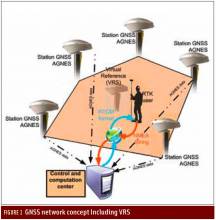
Qascom’s ‘Moon Station’ acts as a fixed beacon on the lunar surface, generating ranging signals for nearby users while also computing and broadcasting differential corrections to improve positioning accuracy. At the same time, it supports LCNS monitoring by collecting satellite observables directly from the surface.
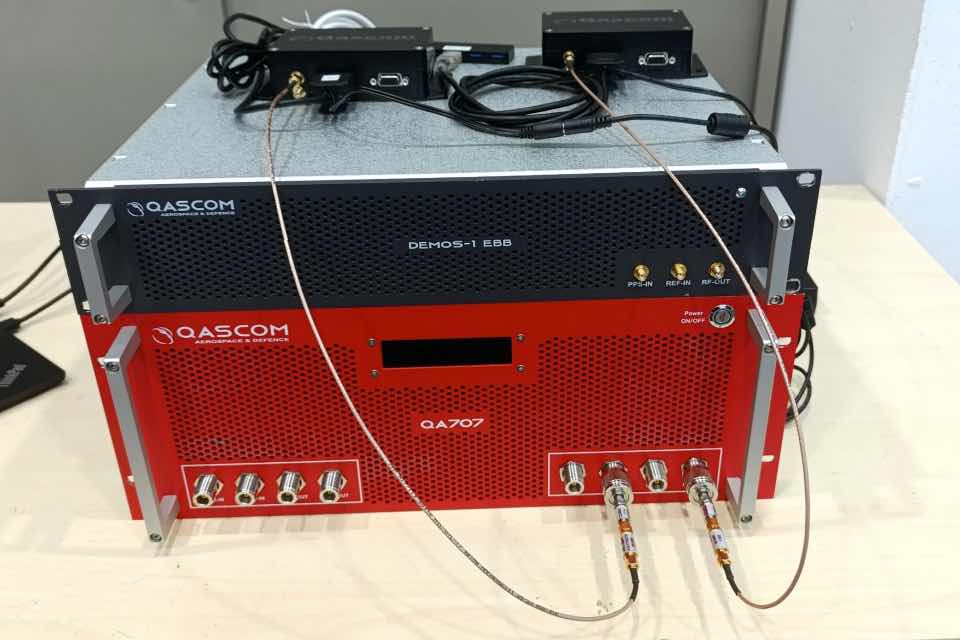
Partners designed a complete flight-model and developed an elegant breadboard (EBB) demonstrator integrating the most critical subsystems. The proposed payload architecture combines an LCNS navigation receiver, a configurable navigation beacon transmitter and communication modules enabling links to lunar users, LCNS satellites and Earth.
Designed assuming deployment near the lunar South Pole, the station has a mass of roughly 180 kg and peak power around 440 W. Considerable effort was devoted to thermal and operational analyses, defining survival, active and operative modes to ensure functionality through the lunar day-night cycle, where temperatures can drop below -150°C.
The end-to-end testbed enabled realistic experimentation with S-band navigation signals, ranging observables and differential corrections, as well as performance comparisons using weighted least squares and extended Kalman filtering.
Aiming for the Moon
Project results were presented at a recent ESA-hosted event by Qascom technical manager Luca Canzian and Stefano Garlaschi, responsible for navigation engine development, along with OHB Italia’s Isacco Pretto, who coordinated the overall Moon Station design.
Differential corrections were shown to significantly reduce user range errors, particularly when exploiting pilot signal components. When combined with digital elevation models and EKF processing, simulations achieved meter-level positioning accuracy and substantial improvements in vertical performance across areas spanning hundreds of kilometers.
The team also demonstrated meaningful reductions in orbit-determination-induced errors, with surface-generated corrections remaining effective over several minutes for both static and mobile users.
Canzian described the demonstrator as an important milestone toward operational lunar PNT infrastructure. By extending SBAS-like concepts to the Moon, combining orbital navigation assets with surface reference stations, the project points to a resilient, high-integrity navigation framework for future robotic and human exploration.