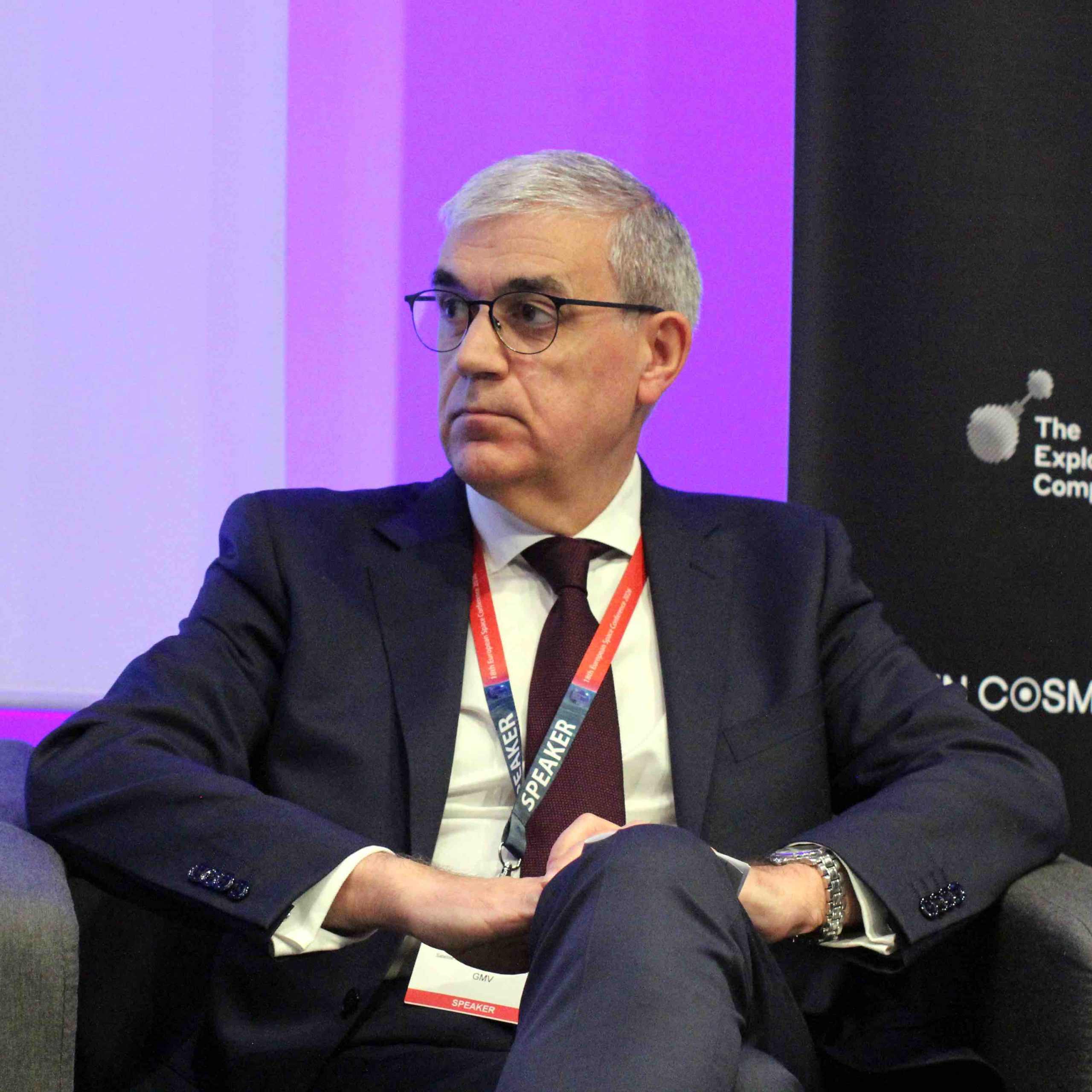
In a high-level discussion at the recent European Space Conference in Brussels, GMV General Manager of Navigation Systems Miguel Romay framed the future of Europe’s satellite navigation ambitions around three priorities. “The key parameters,” he said, “are service continuity, resilience, and innovation.”
These elements cannot be treated independently. “Imagine you have a system that provides good service continuity,” he said, “but it’s not resilient. In the end, the users will not be there. Or, say, you do a lot of innovation but you don’t have service continuity. You won’t have the trust of the users or the institutions.”
Europe starts from a position of strength: “We should be proud,” Romay said. “EGNOS and Galileo are performing very, very well and have earned confidence by providing the performance, continuity, and high accuracy.”
New challenges
Romay described a changing threat landscape. “We are not facing the same situation we were 10, 15 years ago. Today when we talk about interference, jamming or spoofing, it’s not a theoretical risk. It’s an operational reality. So resilience is now a core requirement. It’s fundamental.”
New capabilities must be introduced without compromising trust. “There are new users coming in,” Romay said. “There are new applications, there are new markets, so we can’t forget new user requirements and needs as we integrate signals, receivers and sensors.”
In this context, The European Space Agency has launched its LEO-PNT initiative (Celeste) to strengthen resilient satellite navigation services. Romay said, “Celeste is an important asset for Europe. It is not a replenishment of the current system, it is a complement. It will enhance resilience, enhance the flexibility of the system and will add some innovation capacity. LEO-PNT can be a dynamic component of the European navigation system, because the life cycle of these satellites is much shorter.”
Romay also cited the Public Regulated Service (PRS), Galileo’s encrypted service for secure governmental positioning. “PRS is coming,” he said, “and we need to have receivers, to be able to use PRS in different environments.” GMV is working on this. “So we have a big challenge in front of us,” Romay said.
Given his company’s deep involvement in Europe’s satellite navigation project, Romay knows what it takes to deliver resilient, trusted systems for users across the continent and the world, and we mark his words.