Many hot-button issues were tackled, including the challenge with U.S. PNT governance and why the U.S. has fallen behind.
Unlike many PNT-related events, the Defense Strategies Institute’s annual Assured PNT (APNT) Summit has always been focused on businesses interested in government direction and policy. Developments in technology are discussed of course, but attendees also hear from government leaders about everything from high-level strategy to, in some cases, the right staff person to contact about contracting opportunities.
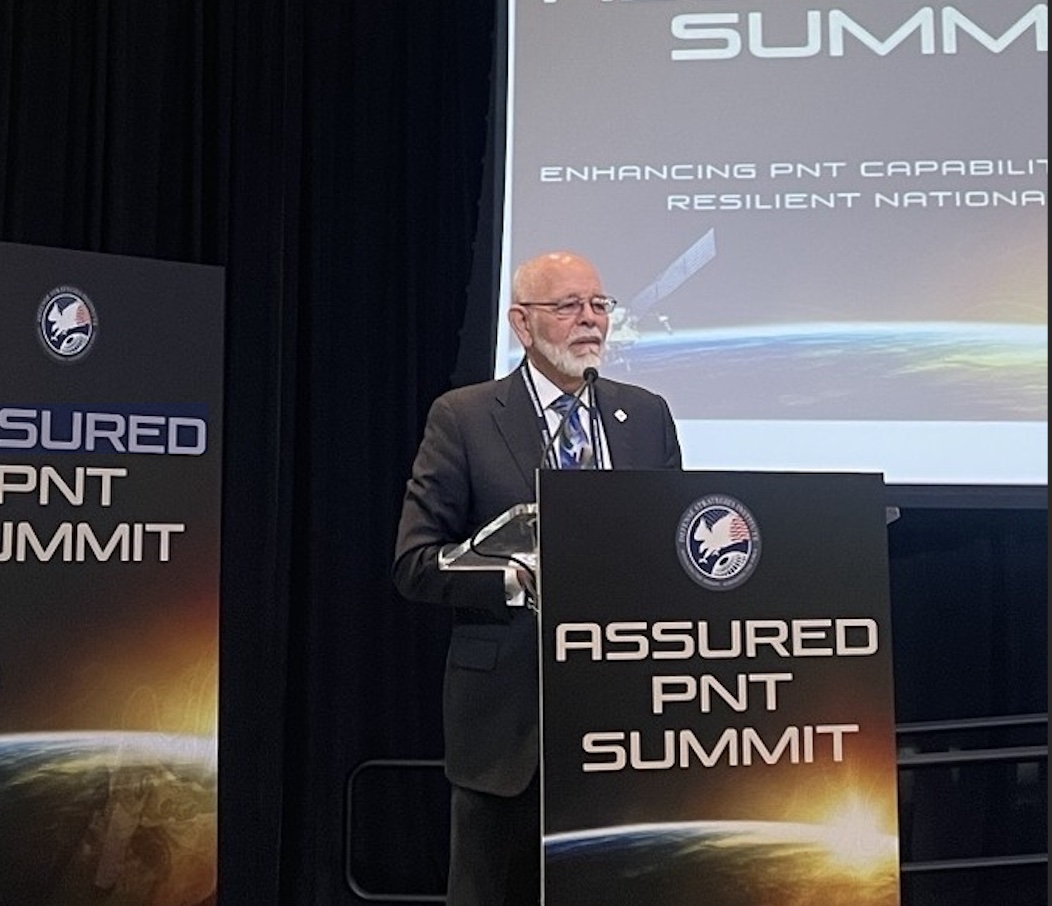
I was privileged to again be the moderator at the most recent summit, which was held, as always, in the Washington, D.C., area. This year, I was struck by the general consensus among attendees on a number of issues spanning technology and policy.
The event is governed by the Chatham House Rule. So, while I can relate what was said, who said it, their organizations, etcetera must remain, with a few exceptions, confidential. In fairness, though, all of the following points were mentioned by more than one speaker and there seemed to be general agreement among the 200+ attendees.
The theme of the summit was “Developing a Robust Resilient National PNT Architecture for U.S. Dominance.”
Here are some of my takeaways:
Requirements
While all users and applications have specific PNT requirements, many folks don’t really know what they need and just default to GPS/GNSS. When asked about performance requirements for future PNT systems, many program managers respond by asking about what is possible. This “what do you need?”/ “what can I have?” cycle can be frustrating for providers.
Adoption
Adoption often requires integration and can be expensive. User equipment (MGUE) for M-Code was given as an example several times. Putting satellites in space is less expensive than the required networks and user equipment on the ground. Modular open system architectures (MOSA) will help with new builds, but legacy systems are a significant challenge.
Integration
Integration is difficult and expensive. Platforms are highly varied and it is expensive to develop and execute a program to integrate new signals and systems for each one. The sheer number of platforms that use GPS is huge. Again, MOSA will help a lot, but its biggest impact will be with new systems.
Dual Civil/Military
America’s experience with implementation and adoption of GPS can provide a number of lessons for future systems. Among them is the benefit of dual use—military and civilian. That’s fostered through a virtuous cycle of broad research, lower size-weight-power-cost user equipment economic order quantities, and greater adoption.
PACE
Primary, Alternate, Contingency, Emergency (PACE) was cited several times as a systems engineering way to look at a layered PNT approach. GPS/GNSS will be primary for the foreseeable future. Emergency will likely always be paper maps, looking out the window, dead reckoning, and the like. This helps organizations focus on determining which systems should be used for Alternate and Contingency.
Quantum
Practical and affordable clocks and sensors are getting closer. Size, weight, power and cost still remain challenges. Engineering work to enable manufacture at scale is also needed. The technology has the potential to be widely commercialized in 10 years or so.
“America is so far behind!”
Most attendees found a presentation by Wing Commander Mark Brammer from the United Kingdom both inspiring and a bit discouraging (he was happy to have his remarks exempted from the Chatham House Rule). Brammer discussed the need to move away from over-dependence on space and how the UK established a cross-government office to coordinate national PNT efforts to ensure both military and civil PNT needs are met.
He described Britain’s plan for a resilient national PNT architecture, which has been funded and is being executed. It involves a very robust fiber timing network with three timing centers, an eLoran network that will serve the British Isles and adjacent maritime approaches, and integration with space-based PNT sources.
Governance
Numerous comments from panelists and attendees identified governance as the primary reason the U.S. is so far behind the U.K. in the journey to PNT resilience.
Multiple mature technologies are available. Cost was not seen as a principal obstacle, and the phrase “for less than the cost of putting one MEO satellite in space …” was heard more than once.
The group consensus was that America’s governance structure is so dispersed, we are handicapped in our ability to decide and act. One attendee commented “Everyone is responsible, so no one is responsible.”
This view has also been articulated by the President’s National Space-based PNT Advisory Board, though in that case U.S. PNT resilience was compared to that of China. APNT governance shortfall was also called out by attendees at September’s PNT Leadership Summit hosted by the RNT Foundation and Inside GNSS.