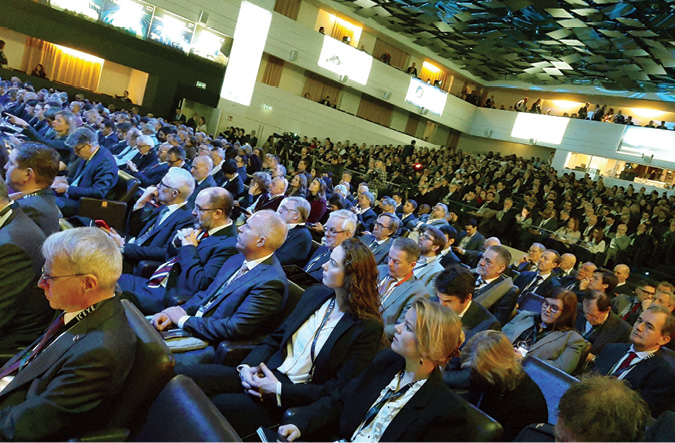
Every January, the neighboring capitals of Paris and Brussels host back-to-back gatherings that set the tone for the year ahead in European space. At this year’s European Space Agency (ESA) Director General’s press briefing in Paris, Galileo, low Earth orbit (LEO) PNT and launchers took center stage, while the 18th European Space Conference in Brussels highlighted defense and security, autonomy and strategic partnerships.
ESA Outlook
By any metric, ESA enters 2026 with unprecedented momentum. At his annual press briefing in Paris, Director General Josef Aschbacher outlined the new year against the backdrop of a historic €22.3 billion ministerial subscription secured at the ESA 2025 Ministerial Council in Bremen, a level of political and financial commitment that, for the first time, fully matched ESA’s own programmatic proposal. That mandate is now being translated into hardware, services and, increasingly, strategic autonomy in positioning, navigation and timing (PNT).

Navigation remains one of ESA’s most important portfolios, not least because it sits at the intersection of civil, commercial and security users. Galileo continues to be the backbone of Europe’s sovereign PNT capability, and Aschbacher confirmed that 2026 will see another major step forward with the L15 Galileo launch in the fourth quarter, adding further satellites to the constellation and reinforcing service continuity and performance.
Galileo already delivers some of the most precise open and encrypted navigation signals in the world, but ESA is looking beyond medium Earth orbit (MEO) to harden and extend those capabilities. A central highlight of the briefing was Celeste, ESA’s LEO PNT in-orbit demonstration, scheduled for launch in the first quarter.
Celeste is intended to enhance resilience, robustness and accuracy by exploiting LEO’s geometry and signal strength advantages. By flying closer to users, LEO PNT satellites can deliver stronger signals, better urban and indoor penetration, and greater resistance to jamming and spoofing.
The project is also emblematic of a broader shift toward distributed, multi-layered space infrastructures that are harder to disrupt and easier to replenish, a theme that recurred throughout Aschbacher’s remarks on resilience and autonomy.
Launchers Rising
None of this matters without reliable access to space, and ESA’s launcher story in 2026 is one of regained confidence and accelerating cadence. After years of disruption, Ariane 6 and Vega-C are flying again, restoring Europe’s independent access to orbit and marking a clear return to operational momentum.
Ariane 6 has moved rapidly from its inaugural launch to a growing series of successful missions, an unusually fast progression by historical standards. In a sector where first flights often carry significant technical risk, Ariane 6’s clean early record reflects a mature design and a tightly integrated ground-to-rocket system.
The next milestone is the Ariane 64 configuration—Ariane 6 with four boosters—which is expected to fly on a commercial mission this year and will serve as a critical qualification step toward full operational cadence. Beyond Ariane and Vega, ESA’s European Launcher Challenge, heavily oversubscribed relative to requested funding, is laying the groundwork for the next generation of European launch systems, driven by industry innovation but underwritten by public commitment.
Looking ahead, Europe is preparing for a markedly busier launch schedule. A mix of navigation, science, security and commercial missions, including further Galileo deployments, will keep positioning, navigation and timing firmly in focus, while demonstrating that Europe’s launcher ecosystem is once again scaling up. Together, these developments signal not just a technical recovery, but a renewed strategic confidence in Europe’s ability to sustain autonomous access to space and support the growing demands of security, connectivity and economic resilience.
So, Galileo is not standing still, LEO-based augmentation is coming, and Europe is investing heavily to ensure its navigation and timing capabilities remain accurate, resilient and sovereign in an increasingly contested space environment.
To the Capital of Europe
While Europe now appears fully committed to pursuing its own sovereignty in space, it remains an ally of the United States, maintaining strong cooperation on shared space security and GNSS interoperability. However, recent ups and downs in that relationship have given Europe pause. With a clear adversary on its eastern flank and a longstanding partner to the west signaling that Europe must shoulder more responsibility for its own defense, European policymakers are confronting a more complex geopolitical reality.
To be clear, strategic autonomy for the old continent is not a rejection of alliances, but a necessary complement to them. The growing recognition of the shifting balance between partnership and self-reliance hung over this year’s European Space Conference in Brussels, not like a cloud but like a light bulb, switched on.
Opening the show at The Square was Andrius Kubilius, European Commissioner for Defense and Space, who reviewed his first year in office amid rising geopolitical pressure. Navigation was a core pillar. Marking 10 years of Galileo, Kubilius said the system is expanding into security-critical services. He highlighted Galileo’s new Open Service Navigation Message Authentication (OSNMA) service to counter spoofing, and the imminent Galileo Public Regulated Service (PRS), describing it as “a robust, autonomous European system our soldiers can rely on.” Meanwhile, further launches and work on the next-generation constellation solidify Galileo’s role as a strategic enabler.
Geopolitics shaped the Commissioner’s starkest warnings. “No single member state is stronger than Russia,” he said. “If you protect only your own country, your own army, we shall not plan to fight as Europe. Only our unity can deter Putin and defend the European Union.” Kubilius cautioned that while national space investments are rising, fragmentation weakens collective deterrence, urging interoperability by design so sovereign systems can operate.
Priorities under Defense Readiness 2030 include the European Space Defense Shield, Eastern Flank Watch, drone and air defense, early warning, LEO PNT and an Earth Observation Government Service. Kubilius emphasized Europe’s dependence on its ally the United States for space threat data and called for independent surveillance and a partnership of national Space Commands to mobilize European assets in crises or war.
About the newly proposed €131 billion EU budget for defense and space, the Lithuanian said, “And I want a lot of that to go to space. And I know that you want also,” raising more than one chortle in the audience. He closed by highlighting Galileo, Copernicus, and IRIS² as outstanding European achievements, saying, “These are projects that benefit an entire continent that no member state could build alone,” to which all surely agreed.
Galileo Deep Dive
Galileo has been delivering services since 2016, but the system is still evolving. In a closed-door interview in Brussels, Guerric Pont, Head of Galileo Exploitation at EUSPA, told Inside GNSS, “Galileo has now marked the shift from a development program to operational service.” One of the most important recent milestones is the declaration of the OSNMA service, which was recently demonstrated in the Baltic region. Pont stressed its practical importance for public authorities and critical infrastructure.
Recent satellite launches have also marked a turning point. Galileo’s first mission on Ariane 6 was a success, and Pont paid tribute to the launcher’s performance: “We got an injection accuracy that was twice better than what we got when we launched on Falcon 9.” The newly deployed satellites are now being maneuvered into their final orbital slots, with payload testing underway.
Again, technical advances in Europe are today inseparable from geopolitics. Pont recalled how Russia’s invasion of Ukraine abruptly exposed Europe’s dependence on Soyuz. “We saw this when Russia invaded Ukraine, all of a sudden we had the launcher crisis because Soyuz was finished.”
He contrasted Europe’s cautious approach to risk with commercial models, noting, “If you see the Musk model, if I may call it that, his risk appetite is, ‘I will go for it, it will blow up, I’m OK.’ In Europe, we are kind of scared of failure.” In their own time, the home-grown Ariane and Vega programs are now restoring Europe’s launch autonomy.
Galileo will continue to roll out new capabilities. The PRS is expected to be formally declared soon. The Emergency Warning Satellite Service (EWSS) will allow authorities to broadcast authenticated alerts during disasters. A new Signal Authentication Service (SAS) will verify that signals are not coming from malicious transmitters. And High Accuracy Service (HAS) Phase 2 aims to dramatically cut convergence times.
“Independence is now more necessary than ever,” Pont said, “to make sure the European economy will not collapse depending on third parties and in an evolving political context.” Still, he said, Galileo was designed for cooperation, not isolation: “It was built from day one to be interoperable with GPS, enabling users to combine constellations for better performance.”
Pont also cautioned against viewing GNSS as a standalone solution. Instead, a modern PNT approach should integrate navigation, Earth observation and telecommunications.
OSNMA on Trial
Back at the show, various sessions, conversations, networking coffees and roundtables were bearing fruit, with one standout exchange focusing on how space-based services are becoming mission-critical for European border operations.
Marta Krywanis, Senior Research Officer at the European Border and Coast Guard Agency (Frontex), highlighted the growing operational relevance of Galileo and OSNMA, the first globally available civil authentication service.
She started by describing how rapidly changing threat patterns are reshaping Frontex missions. “Our reliance on space will deepen and diversify because the threats at the borders are changing so dynamically,” she said, pointing to hybrid warfare, migration and geopolitical shocks as drivers of growing demand for real-time, integrated data.
Krywanis also outlined concrete operational challenges, from secure command and control to rapid data fusion and cybersecurity. “Security must be embedded in design to ensure resilience and trust in data for our operations,” she said, noting autonomous surveillance systems and unmanned vehicles depend on reliable GNSS and Earth observation to function effectively.
Fiammetta Diani of the European Union Agency for the Space Program (EUSPA) called Galileo OSNMA a key enabler in Europe’s drive to secure space, and said close cooperation between agencies is essential to turn space capabilities into dependable operational tools on the ground and at sea.
A key example is the Black Sea pilot project, officially the “Galileo-enabled Asset Tracking Demonstrator Pilot Project,” where Frontex, EUSPA and the Romanian Border Police tested OSNMA-authenticated Galileo tracking on vessels. The demonstrator explored secure and resilient positioning under real operational maritime conditions, validating how OSNMA can help authorities distinguish authentic signals from potential spoofing attempts.
Diani emphasized the broader significance of the effort: “This pilot shows how European space capabilities, especially Galileo, can directly support critical missions such as border surveillance.” And that’s the truth. She added that projects like this help shape future operational use of authenticated navigation and integrated space data.
The takeaway: As border operations grow more complex and contested, space-based tools like Galileo OSNMA are no longer optional enhancements; they are becoming foundational to Frontex’s ability to operate, maintain situational awareness, and respond effectively to evolving threats.
Recent reporting by Inside GNSS highlights how immediate these threats have become, with Baltic and North Sea states formally blaming Russia for sustained GNSS disruption. Coastal nations are now treating interference with satellite navigation as a security threat, signaling a shift toward stricter enforcement and accelerated development of backup navigation systems.
Moving Toward Resiliency
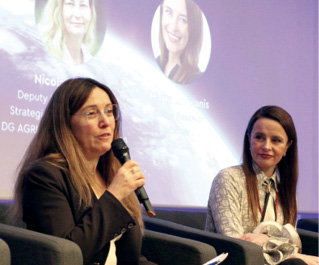
In another discussion on the challenges facing GNSS, Christophe Grudler, Paul Flamant, Francisco-Javier Benedicto Ruiz, and Rolf Kozlowski compared notes on resilience, sovereignty and the future of European positioning.
Grudler, Member of the European Parliament and co-chair of the Sky and Space Intergroup, opened on a positive note. “Galileo is a big European success and we need to say it every day,” he said, “but we need to understand, jamming and interference are now concrete threats on European soil.”
Grudler regretted that the Galileo PRS is still not fully deployed, saying, “If everything had been well done, we should have had all our European military airplanes, boats and soldiers using PRS today. It is not the case. And a robust and secure signal like PRS may have prevented some recent incidents.” For Grudler, the lesson is geopolitical as much as technical. Without placing blame, he shared some well-earned words of wisdom: “Digital and technological sovereignty require political courage and long-term vision.”
Flamant, Head of Unit for Satellite Navigation at the European Commission, stressed continuity as much as innovation. “The most important thing we have to do today is to keep our users satisfied,” he said, pointing to Galileo’s first generation while praising the second generation as “a quantum leap.” On interference, he was blunt: “The radio frequency spectrum is polluted by enemies or by malicious, intentional people.”
Flamant spoke positively of the PRS, which he said is coming very soon, and he framed LEO PNT pragmatically, noting, “We have to consider with ESA the different possible architectures, and we are still analyzing what would be the best missions for such a system.” On GNSS sovereignty, he challenged the idea of a paradigm shift: “With Galileo, sovereignty is already built in, and it has been from the beginning,” agreeing with his EUSPA colleague Pont.
ESA Director of Navigation Benedicto emphasized engineering depth and diversification. “The first and utmost priority is to make sure that the services we are providing today are robust,” he said, pointing to PRS, Galileo second generation, and EGNOS upgrades. He described ESA’s multilayer vision, where EGNOS, Galileo, and LEO PNT converge into a single “EU PNT” experience for users. In the context of ESA’s Celeste program, Benedicto said resilience would come through diversity of signals, orbits, frequencies, to be joined, in the future, by optical and quantum technologies.
Managing Director of DLR GfR Kozlowski brought the concerns of Galileo Control Centre in Oberpfaffenhofen into focus. He talked about new global maps of jamming and spoofing hotspots. “We are able with these to sometimes detect incidents days before they reach the news,” he said. “This is knowledge which has to be distributed all over the world,” noting its value for both civil aviation and armed forces.
The conversation circled back to geopolitics and the United States, with Grudler recalling early American skepticism of Galileo and concluding that collective European action is the only path to sovereignty. Flamant concurred, stressing coordinated investment over fragmentation. Everyone agreed that rising jamming and spoofing incidents, and security pressures, are accelerating the move toward a resilient, sovereign, multi-layered European navigation system.
Call to Arms
From navigation resilience to military readiness, the conversation steadily shifted from technology to deterrence. In the big hall, Italian Air Force Chief of Staff General Antonio Conserva called space a frontline of modern security, warning Europe is entering a fundamentally new strategic era. “High-intensity warfare is back in Europe,” he said. “Russia’s invasion of Ukraine should be a wake-up call for all of us.” If they hadn’t been before, the attendees were certainly awake now.
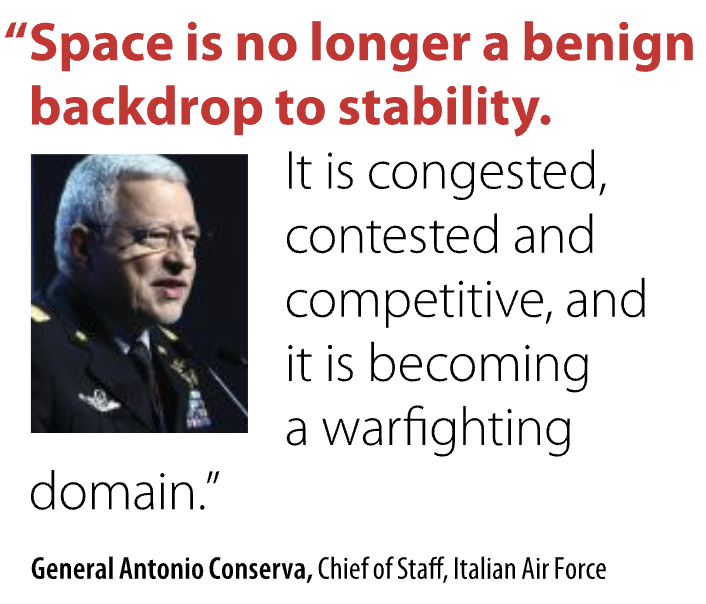
Conserva described a world marked by great-power competition, technological acceleration, and persistent instability, noting that space now sits at the center of deterrence and credibility. “Space is no longer a benign backdrop to stability,” he said. “It is congested, contested and competitive, and it is becoming a warfighting domain.”
Space is already relevant to conflicts on Earth, he said, because attacks on satellites and GNSS-enabled infrastructure can disrupt communications, navigation and decision-making. Europe is finally responding: “We are witnessing an unprecedented European awakening to reality.” He pointed to the EU Space Strategy for Security and Defense and growing investment as proof that space is now recognized as “an operational dimension of our sovereignty.”
But awareness is not enough. “We must now translate momentum into capability,” Conserva said, citing three urgent priorities. First is space domain awareness. “In a warfighting domain, you cannot protect what you cannot see,” he said, arguing for a federated European sensor network to eliminate blind spots and provide verified military-grade information.
Second is resilience. “This is an operational need, not merely an industrial slogan,” he said, emphasizing assured access to services such as communications, Earth observation, and navigation even when under attack. He highlighted the importance of dual-use systems and layered architectures, noting Europe must be able to rapidly reconstitute degraded capabilities. “The ability to replace a degraded asset in hours instead of months acts as a formidable deterrent,” he said.
Third is credible capability and collective deterrence. Industrial fragmentation weakens Europe strategically and called for coordinated responses to hostile activities. “If we respond in a coordinated way, backed by credible capability, our deterrence will hold,” Conserva said.
On partnerships, he said, “The partnership with the United States remains central and crucial to space security,” while also urging deeper cooperation with NATO on interoperability and threat sharing. He closed with a call for unity and pragmatism: “The future of space security will belong to those who can understand faster, endure longer, and act together.”
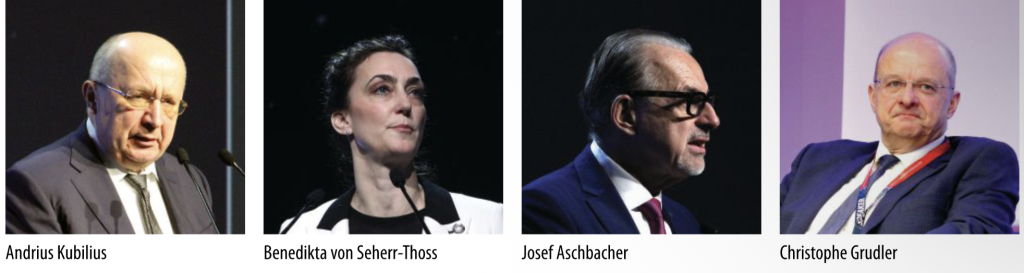
Following the General, Benedikta von Seherr-Thoss, Managing Director for Peace, Security and Defense at the European External Action Service (EEAS), delivered a blunt assessment of Europe’s security environment, stressing that while calls for stronger European defense are not new, what has changed is the urgency. She appeared to agree with the current American administration when she said, “Europe needs to be able to deter and defend itself, and it must take responsibility for its own defense.”
She emphasized that Europe’s expanding space and defense capabilities are meant to reinforce NATO and transatlantic interoperability, with a stronger European pillar designed to complement the Alliance and strengthen collective security. As for the drivers behind this shift, von Seherr-Thoss pointed to Russia as a lasting threat.
Space, she argued, must be treated as a core element of the effort to reduce dependencies, fill capability gaps, and acquire key military capabilities.“Conducting war without services from space is not possible,” she said, highlighting secure communications, geospatial intelligence, navigation, and targeting as mission-critical enablers.
Von Seherr-Thoss also stressed dual use. “This means understanding defense requirements and integrating them in design,” she said, “so that all capabilities are available when we need them.”
Von Seherr-Thoss outlined a rapidly evolving threat landscape that now includes cyberattacks, jamming, kinetic actions, and more ambiguous behaviors such as close satellite maneuvering. She warned that the consequences on the ground of threats in space could be devastating, pointing to scenarios in which commanders lose communications or forces lose navigation.
Addressing these risks, she argued for tighter cooperation between governments and industry, stressing the need to reduce vulnerabilities while building resilience across Europe’s space systems. She also cautioned against fragmented national approaches, urging unity as Europe moves toward initiatives such as the European Space Shield. This is a new flagship initiative within the EU’s Preserving Peace—Defence Readiness Roadmap 2030, aimed at enhancing the protection and resilience of Europe’s space infrastructure, including systems such as Galileo and IRIS².
Men in Uniform
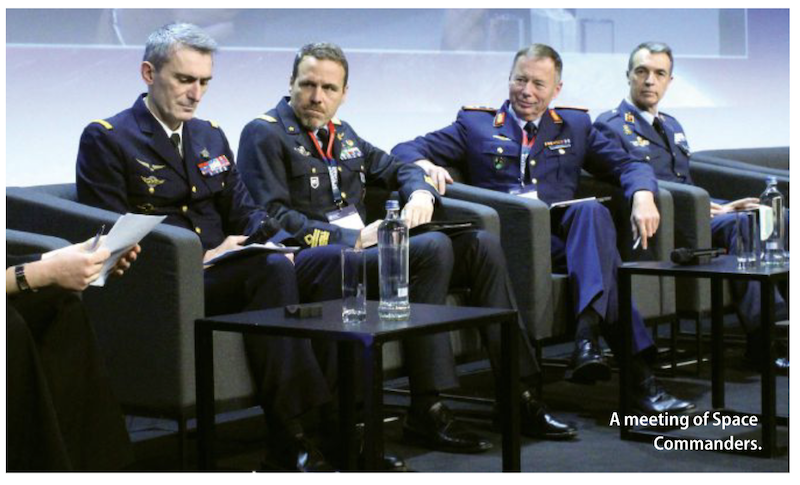
In a (literally) star-studded event, a “meeting of space commanders,” Major General Isaac Crespo Zaragoza, Commander of the Spanish Space Command, said what everyone by this time already knew: “There’s no military operation that can be done the way we train without space. Command and control, maneuver, intelligence, fires, and force protection all rely on orbital systems.”
As dependence grows, so do vulnerabilities, Crespo said, warning that adversaries are now actively seeking to disrupt space-enabled services. “We are not talking about only knowing what’s going on in space,” he said. “We are talking about space security.” He called for systems designed with built-in resilience and self-protection, alongside stronger Space Situational and space domain awareness.
Positioning, navigation and timing remain a critical gap. European forces still rely heavily on GPS, Crespo said, highlighting, as did MEP Grudler, delays in operationalizing the Galileo PRS. Spain currently fields no military assets using PRS, largely due to unfinished terminal development and integration.
Beyond PNT, Crespo referenced resilient SATCOM, IRIS², combat cloud connectivity, space-based early warning, and the emerging idea of a European space shield. But he cautioned that Europe must move beyond technology demonstrations. “Most of the European Union programs are focused on developing some technologies from TRL to seven or six, but at the end we don’t have any capability being delivered,” he said.
For Europe’s space commanders, it would seem, the timeline for deterrence has collapsed; space war is here. Major General Michael Traut, Commander of German Space Command, warned the strategic challenge is no longer abstract or distant. “The appointment is not for 2029, it’s now,” he said, arguing that Europe must rapidly, if not immediately, develop a shared operational picture and common standards.
But sensing alone is not enough. “It’s not only a question of being able to observe things, so we need to be able to actively act in space,” he added, calling for resilience, on-orbit operations, and even offensive capabilities as part of credible deterrence. “If you were a Roman gladiator, would you want to enter the arena with just a shield?” he asked the audience. At least one of the attendees thought, “No.”
Going back to the conference opening, we remember the European Commissioner’s call for “a partnership of national Space Commands.” Others have gone farther, referring to a veritable fully centralized EU Space Command. For his part, Traut emphasized that cooperation must still rest on strong national foundations. “Our first step should be to build up those solid and powerful national capabilities, but to include from the first step of designing them that they should be interoperable,” he said, pointing to Germany’s plans for resilient satellite constellations designed to integrate with IRIS² and other allied systems. A more achievable goal, he said, might be to start developing a common idea on how to command and control space operations together.
Crespo also highlighted the practical barriers to European integration. “I don’t see in the short future that nations will be able to transfer the authority of specific military space capabilities,” he said. Instead, space domain awareness could be a starting point. “The first thing is to cooperate and to set up a common approach,” he said, noting nations are already sharing data to build a recognized space picture.
Crespo cited what he sees as more urgent capability gaps. “Even if I know everything that is happening in space, I cannot protect the system even if they are being threatened, because I don’t have any assets in space to do so,” he said. Like Traut, he believes nations need to go beyond simple awareness to field operational tools.
Rounding out the conversation were Commander Major General Vincent Chusseau of the French Space Command and Commander Major General Luca Manieri of the Italian Space Command. All converged on a single conclusion: Europe must move faster to align national capabilities, Galileo and PRS, and emerging EU initiatives into a coherent operational framework. The path forward lies in interoperability first, shared awareness second, and ultimately, possibly, coordinated command and control, because in space, readiness can no longer wait.
Also, despite the push for greater European autonomy, the commanders were equally clear that independence does not mean isolation. Space security remains inherently allied.
Traut urged a balance between national and perhaps coalition or Union capabilities, and, above all, cooperation. “Space, regardless of all political turbulence going on, is still a team sport. Our American military colleagues keep saying that, even very recently; we meet every second month somewhere on this small planet. They keep saying it and we will keep saying it. Space is a team sport.”
Clearly Europe’s drive to strengthen Galileo, operationalize PRS, and build resilient national and EU capabilities should be aimed at reinforcing, not replacing, transatlantic cooperation. Interoperability with U.S. systems and continued coordination with American Space Command remain, for now, essential for deterrence and stability.
Soft Landing
Though he is not a GNSS/PNT man per se, we grant the final word to Jens Plötner, State Secretary at the German Ministry of Defense. Drawing down from the exchange of military insights, his general views seem perfectly and appropriately applicable to space-based GNSS/PNT matters.
Plötner shifted the focus from diagnosis to responsibility, arguing that Europe’s future in space will be defined less by rhetoric than by resilience. “True European sovereignty increasingly lies in our collective ability to withstand external pressure, coercion and disruption,” he said.
Germany, he explained, is backing that principle with sustained investment, committing €35 billion through the 2030s to build a military space architecture encompassing satellite communications, intelligence, space situational awareness, missile warning, and active defense. Crucially, he said, “This effort is designed not only as a national end in itself, but as a cornerstone of a broader European space capability, aimed at strengthening interoperability across the EU and NATO.”
Plötner emphasized that growing stronger does not mean acting alone. Germany is already working alongside France, Italy, Norway, the UK, Australia, New Zealand, Japan, and the United States through the Combined Space Operations Initiative and the U.S.-led Operation Olympic Defender. He described cooperation with allies as foundational, noting multinational sensor networks, shared imagery, and pooled capabilities can deliver far more than isolated national programs can.
Rather than duplicating efforts, Plötner urged member states to pool and share existing capabilities and ongoing developments. His message was ultimately one of alignment. Europe’s task now, he concluded, is to translate unity into architecture, connecting national investments into a resilient system that safeguards space, supports collective defense, and keeps trusted partnerships at the center of security.