A European Space Agency (ESA)-funded project, led by Thales Alenia Space Italia, has taken a critical step toward establishing reliable navigation services for future lunar missions.
The aim of the ‘Lunar Navigation Payload Demonstrator’ project was the design and development of an ‘elegant breadboard’ (EBB) for the navigation payload of future lunar communication and navigation system (LCNS) satellites. In space engineering terms, an EBB is essentially a hardware prototype designed to represent a real space payload.
Moon exploration is emerging as the next global strategic priority in space exploration. Several dozen commercial and institutional missions to the Moon are already planned for the coming decades, with major contributions expected from ESA, including the Orion service module, ESA participation in the Gateway lunar station and multiple lunar robotic missions. Despite of the wide variety of missions planned for the Moon, a viable lunar navigation and communication infrastructure is not yet available.
The new prototype incorporates functionalities such as signal generation, time-transfer, antenna systems, and laser retro-reflection, providing both an early verification of technical feasibility and a de-risking path for the future LCNS.
New horizon in view
At a recent ESA-hosted event, representatives from Thales Alenia Space Italia, Telespazio Belgium, Italy’s National Institute of Nuclear Physics and Antwerp Space delivered the final project results. They described in detail research and development work and a testing campaign that validated the EBB’s core functions, including signal acquisition, tracking, telecommand, telemetry, and time-transfer.
Subsystems were tested individually and then integrated, with RF, timing, and signal quality all verified successfully. The team noted minor spurious emissions and uplink jitter issues, which were addressed through filtering and design refinements.
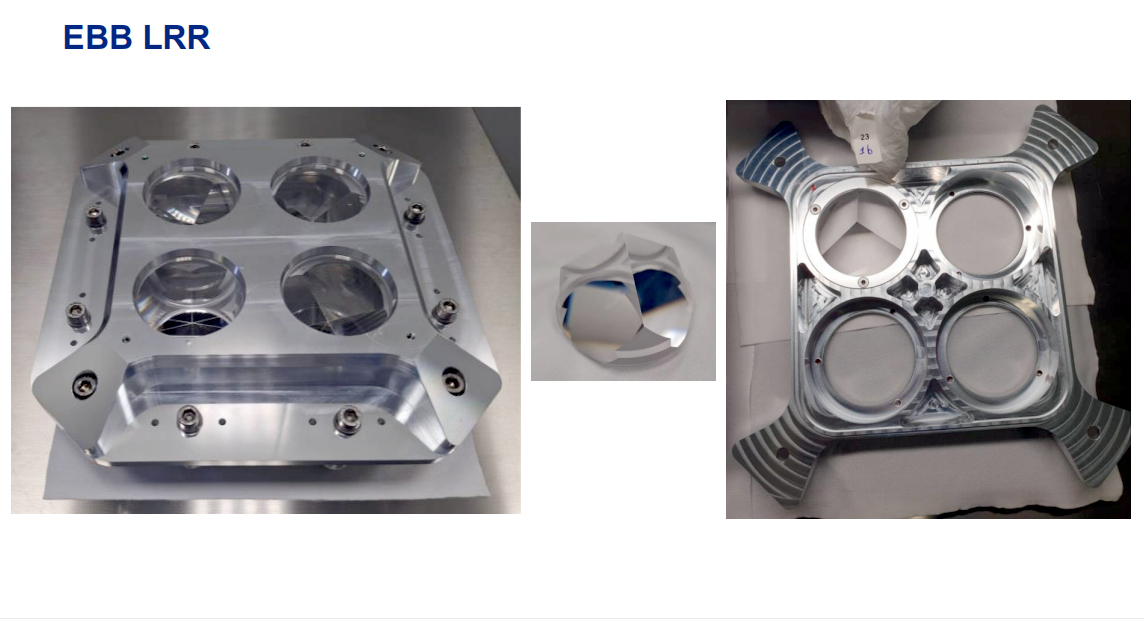
Beyond onboard payload elements, the project also addressed two complementary technologies: a very long baseline interferometry (VLBI) transmitter for lunar surface deployment, enabling VLBI in S-, C-, and X-bands; and a laser retroreflector (LRR), which completed mechanical and optical breadboarding. Together, these technologies support global lunar geodesy and cross-verification of orbital solutions.
In sum, the ‘Lunar Navigation Payload Demonstrator’ successfully validated critical technologies for future lunar navigation systems, confirming compliance with updated lunar navigation interface standards (LNIS). By addressing timing precision, signal generation, antenna design, and ground-based measurement synergies, the work described here establishes a solid foundation for reliable lunar navigation services. Partners said the new system could also contribute to other initiatives beyond lunar applications, e.g. Mars exploration.
This project was funded under ESA’s NAVISP program, aimed at strengthening the European PNT industry.