Since we last reported on the Safran-Xona/TrustPoint integrations, the low-Earth-orbit PNT narrative has advanced decisively, moving from laboratory interoperability tests to tangible in-orbit demonstrations and coordinated industry validation.
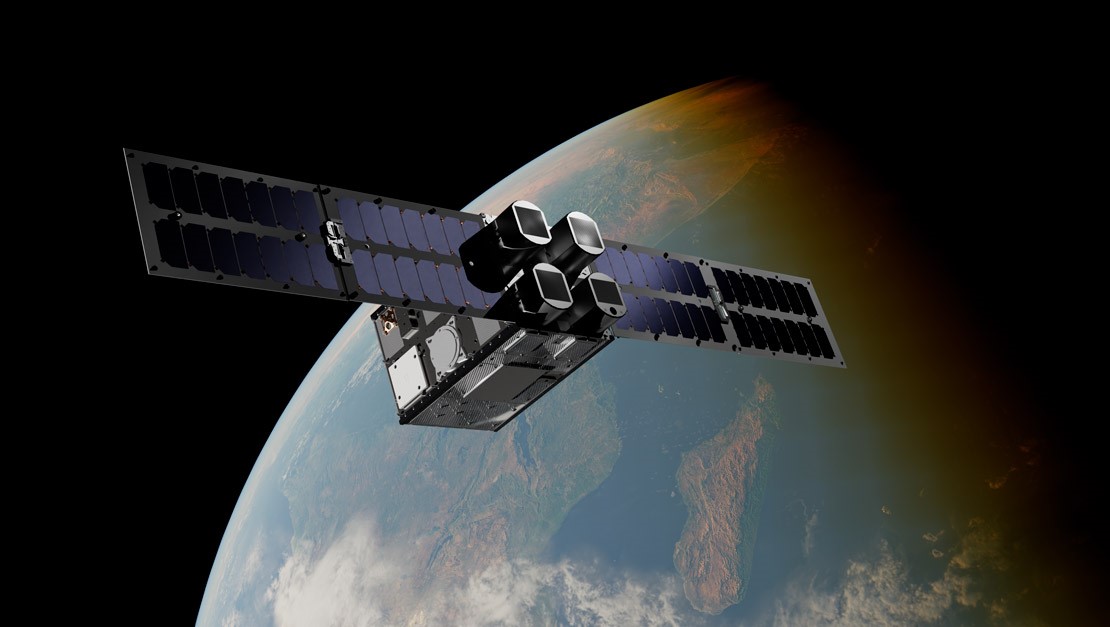
On the U.S. commercial front, TrustPoint has accelerated its flight schedule; in June 2025 the company launched Time Flies, its third LEO craft, expanding capacity for C-band payload experiments and field demonstrations. That growth has been matched by new agreements tying TrustPoint’s on-orbit payloads to receiver development programs, including collaborations with U.S. avionics manufacturers and U.S. Navy test teams, marking a shift from bench-only exercises to operational trials and multi-vendor receiver evaluations.
Meanwhile, Safran announced this autumn that Synchrocube, Europe’s first in-orbit LEO-PNT demonstrator, was operating nominally onboard the Pandore satellite. Synchrocube’s time-transfer and ranging experiments complement parallel U.S. LEO test programs, contributing to a broader global test ecosystem, helping to establish compatibility checks, shared analysis frameworks, and cross-LEO performance baselines.
Xona’s Pulsar program now draws these threads together in a practical workflow shared across the testing community. Pulsar-0 lifted off in June 2025 and, within weeks, Xona recorded watermarked ranging codes and released what it described as the first authenticated pseudorange measurements from orbit, a cryptographic ranging proof designed to help receivers validate signals and resist spoofing. These authenticated codes have already been ingested by both U.S. and European receiver labs, which are using them as a common benchmark for LEO-signal processing.
Call and response
Crucially, Safran’s September certification of its Skydel simulator to emulate Pulsar signals closes the loop between actors. With Skydel now able to generate TrustPoint-like, Xona Pulsar, and Synchrocube-profiled LEO signals in a single environment, receiver manufacturers and test agencies can run multi-constellation LEO scenarios blending U.S. commercial and European demonstrator waveforms. For the first time, simulation, on-orbit measurement, and receiver integration efforts across the Atlantic are aligned in timing, format, and authentication design.
Europe’s receiver industry is responding. Belgian firm Septentrio reported early tracking of Pulsar-0 and signed a memorandum to accelerate joint testing with Xona aimed at validating centimeter-level performance and enhanced indoor availability. Other partnerships show European vendors incorporating U.S. LEO signals directly into GNSS stacks rather than treating them as standalone supplements.
Across all participants, recent work has sharpened focus on classic LEO tradeoffs, including higher carrier-to-noise and improved geometry versus rapid Doppler dynamics and short dwell times, forcing reconsideration of loop bandwidths, TTFF strategies, and spoof-resilience measures.
For followers of U.S./EU PNT developments, the message is clear: Europe, through Synchrocube, is demonstrating sovereign LEO-PNT capability, while U.S. commercial firms push operational services. Together, these efforts are shaping a global ecosystem where verified simulations and authenticated signals form the basis of trust heading into 2026.