
Main Categories

January 24, 2008

GPS Block IIF Satellite to Enter New Round of SMC Tests

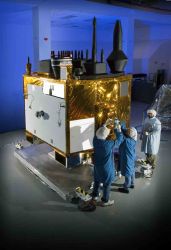
Block IIF satellite undergoing tests at Space & Missile Systems Center, Los Angeles Air Force Base, California

Having successfully passed its initial phase of tests at the Space & Missile Systems Center at Los Angeles Air Force Base, the first GPS Block IIF (follow-on generation) satellite is expected to enter the second round of thermal vacuum testing in late March, according to the GPS Wing.

On December 24, the GPS IIF program completed the first of two phases of thermal vacuum testing on the first IIF space vehicle (SV-1) built by The Boeing Company. This was "a major success for the program," in the words of GPS Wing officials. Thermal-vac tests exposed the spacecraft to extreme hot and cold temperatures under vacuum conditions to verify system performance and correlate the thermal models, according to the GPS Wing.

Read More >

By Glen Gibbons
January 17, 2008

AFIT Releases GPS System Engineering Case Study

The GPS constellation, as illustrated 30 years ago.

While awaiting the arrival of the definitive history of the Global Positioning System, students of the premier GNSS program might want to take a look at a systems engineering case study released last month by the Center for Systems Engineering at the Air Force Institute of Technology (AFIT), Wright-Patterson AFB, Ohio.

Read More >

By Glen Gibbons
January 16, 2008

Raytheon Paveway Sales at Record Pace

Enhanced Paveway II

Raytheon Company received more than $150 million worth of contracts in December for its Paveway family of precision-guided munitions. The latest figures bring the total Paveway year-to-date bookings for 2007 to more than $300 million, a record for Raytheon’s Paveway program.

The contracts are a combination of direct commercial sales and foreign military sales and will provide customers in Europe and Asia with the Enhanced Paveway II (EP2) and the EP3 variants of the Paveway weapon system, which upgrade "dumb bombs" into precision-guided munitions.

Read More >

By Glen Gibbons
[uam_ad id="183541"]
January 15, 2008

WAAS coverage expands to Canada and Mexico

On September 28 2007, Wide Area Augmentation System (WAAS) coverage was expanded
into Canada and Mexico, according to the Federal Aviation Administration.

This achievement was made possible by the integration of nine new international wide-area reference stations (WRS) into the WAAS network. In addition to extending WAAS coverage to users throughout large portions of Canada and Mexico,
this expansion also benefits the U.S. WAAS users within the U.S., formerly on the fringes of WAAS coverage, are now well within its coverage boundaries.

Read More >

By Inside GNSS
January 6, 2008

Galileo’s GIOVE-B to Launch April 14

The first Galileo experimental satellite, which marked its second anniversary in space on December 28, may soon have company.

Designated the Galileo In-Orbit Validation Element–A (GIOVE-A) satellite, the spacecraft has been broadcasting a variety of signals since January 2006, using on-board rubidium clocks for time-tagging signal transmissions. Now, GIOVE-B — the larger second experimental satellite, which will carry one hydrogen maser and two rubidium clocks, is nearing readiness for transfer to the Russian Baikonur launch facility in Kazakhstan.

Read More >

By Glen Gibbons
[uam_ad id="183541"]

Russia’s Home-Grown GLONASS-GPS Receiver

What may be the first domestically produced, consumer-oriented GLONASS-GPS receiver, sold out shortly after their introduction in Russia’s Ion retail stores.

The Glospace SGK-70 features a 12-channel GLONASS receiver and a 20-channel GPS receiver, which can reportedly use either or both systems simultaneously. Designed primarily for in-vehicle use, the 7.4×4.7×1.2-inch unit incorporates Samsung components has an SD/MMC slot and comes with a 512MB card that includes detailed maps of the Moscow area.

Read More >

By Glen Gibbons
January 5, 2008

Moscow SatNav Forum 2008

Yuri Urlichich, RISDE Director General

Coming on the heels of two successful launches of six GLONASS spacecraft in recent months, the second edition of Russia’s International Satellite Navigation Forum will take place April 7–8 in Moscow at the Russian Academy of Sciences.

The event follows a successful inaugural conference in April 2007, which drew a wide range of government and commercial participants. A commercial exhibition will accompany the forum, which will have simultaneous translation available in English.

Read More >

By Glen Gibbons
January 3, 2008

India’s GAGAN Passes Its Final Test

The Raytheon Company has announced that it successfully completed the final system acceptance test to augment standard GPS signals over India.

GAGAN stands for GPS Aided GEO Augmented Navigation-Technology Demonstration System. It monitors GPS satellite signals for errors and then generates correction messages to improve positioning accuracy for users.

Read More >

By Glen Gibbons

DoD Issues ‘Roadmap’ for Unmanned Systems

A 25-year (2007-2032) U.S. Department of Defense (DoD) roadmap for unmanned systems reflects the critical contribution of GPS technology in a growth area for tactical military systems that are simultaneously seeking a compatible place in civil applications and the national air space.

Read More >

By Glen Gibbons
December 21, 2007

NXP Semiconductors to Buy GloNav

NXP Semiconductors has announced plans to acquire GloNav Inc., a US-based fabless GNSS semiconductor company, for $85 million in cash. The deal is expected to close in the first quarter of 2008, subject to regulatory approvals.

According to NXP, the company plans on integrating GloNav’s GPS technology with NXP’s expertise in Bluetooth, FM radio, and USB “to offer a broader connectivity suite to the mobile phone market.”

Read More >

By Glen Gibbons
IGM_e-news_subscribe