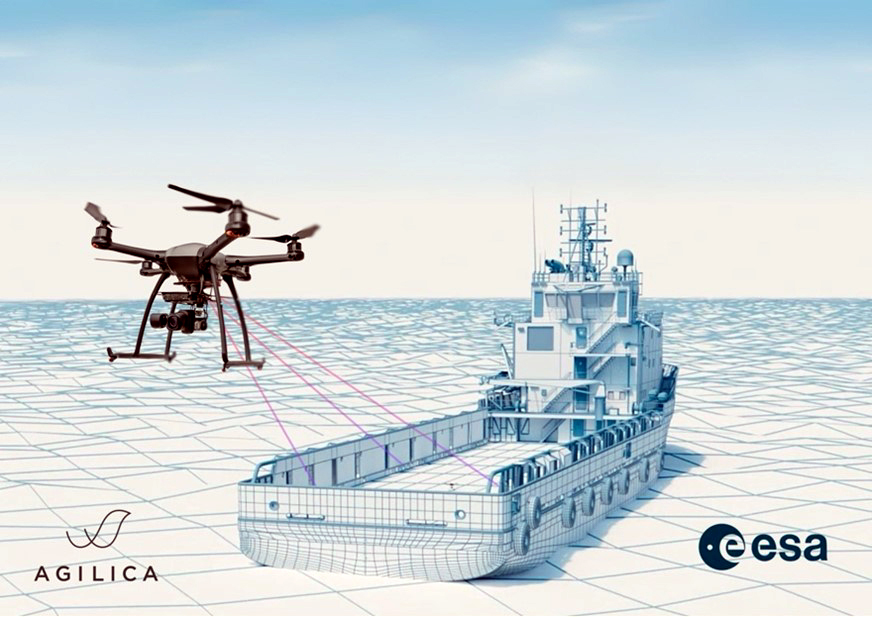
Over the past year, Brussels-based Agilica BV has completed major milestones in the ‘Safe autonomous integrated landing system for ships’ (SAILS) initiative.
This Belgian Defense-commissioned research program is aimed at enabling fully autonomous unmanned aerial system (UAS) approach and landing on moving vessels under conditions where conventional satellite navigation can be unreliable or unavailable.
As 2026 begins, heightened GNSS vulnerability concerns make Agilica’s hybrid PNT work very pertinent. The company’s ground-based localization (AGL) positioning system is an alternative PNT solution that blends ultra-wideband (UWB) terrestrial signals with seamless GNSS integration, including the Galileo High Accuracy Service, to extend precision navigation into GNSS-challenged environments.
The underlying architecture operates much like a terrestrial ‘mini constellation’; fixed UWB anchors with known coordinates broadcast ranging signals to mobile tags on UAVs, enabling centimeter-level positioning accuracy even during multipath or signal obstruction that would typically plague GNSS alone.
This hybrid approach was validated earlier in 2025 when Agilica successfully completed a European Space Agency (ESA)-funded feasibility study that confirmed the technical and commercial viability of the AGL system for precision navigation and landing tasks in unfavorable environments, including indoor spaces, offshore platforms and moving vessels at sea. The study demonstrated the system’s ability to augment GNSS with UWB-based local positioning and achieve sub-20 cm accuracy.
High-level coordinated effort
SAILS, funded under the Belgian Defense DEFRA program, with a €1.6 M budget and running from 2025 through 2028, brings together Sabena Engineering, the Belgian Navy, the Royal Military Academy, and Agilica. The consortium aims not just to enable autonomous drone landing but to extend UAV operational envelopes in high seas, harsh weather, and GNSS-challenged environments, essential for military, offshore energy, and search-and-rescue missions.
“Landing a drone on a moving ship is among the toughest navigation challenges in maritime autonomy,” Bart Scheers, COO of Agilica, told the press in late 2025. “With SAILS, we’re moving from concept to operational demonstration, bridging maritime robotics and safe flight operations.”
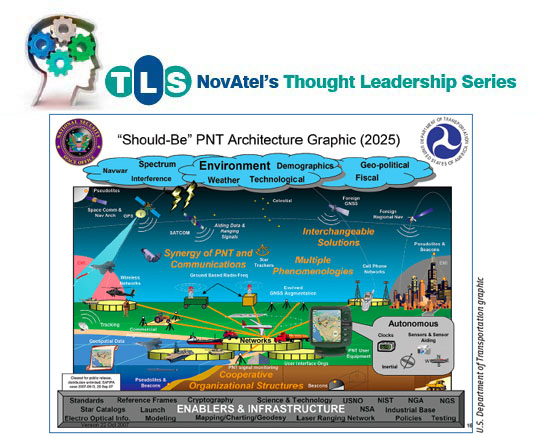
As GNSS vulnerabilities, from interference to signal blockage, increasingly constrain autonomous systems, Agilica’s work reflects a broader shift toward resilient PNT architectures. By combining multi-sensor fusion with terrestrial augmentation, the SAILS project demonstrates how GNSS-centric autonomy can be strengthened for operations in environments where satellite navigation alone cannot meet performance or integrity demands.