Resilience, authentication, complementary systems and timing assurance were among the critical issues covered at this year’s Munich Space Summit, where colleagues from both sides of the Atlantic came together to help define what a resilient PNT future looks like.
The Munich Space Summit remains one of the premier gatherings on the European space calendar, showcasing the accomplishments of leading industry players and policymakers. The Americans show up, too.
Despite current geopolitical strains, Europeans and Americans in the PNT and space communities continue to meet as collaborators, colleagues and, in many cases, longstanding friends. Conferences such as the Munich Space Summit are stronger for that transatlantic exchange.
One of the event’s key sessions, featuring program updates from the major satellite navigation providers, was moderated by Richard Fischer, publisher at U.S.-based Autonomous Media, the company behind Inside GNSS, Inside Unmanned Systems, Inside Autonomous Vehicles and xyHt.
“What strikes me most this year,” Fischer said, “is that the conversation around GNSS has clearly moved beyond constellation updates alone. Across the community, there is growing recognition that GNSS is critical infrastructure. It is no longer enough to think only in terms of accuracy and coverage. The language now is resilience, trust, authentication, continuity and assurance.”
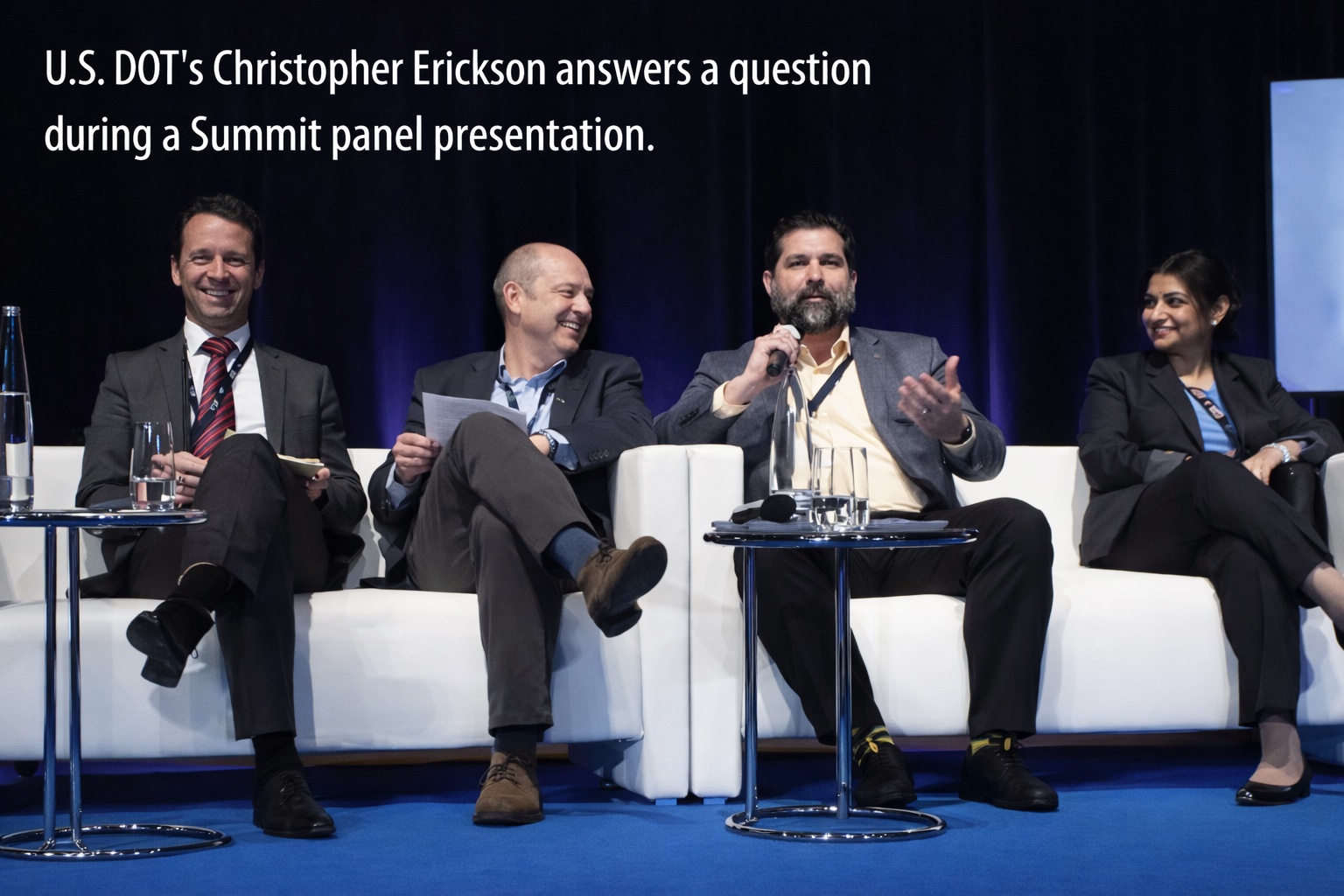
Among the most anticipated appearances at the Summit was that of Christopher Erickson, the new U.S. Department of Transportation Director of PNT and Spectrum Management, succeeding longtime and widely respected GPS leader Karen Van Dyke. Erickson offered a sweeping overview of the current state of GPS, underscoring the extent to which U.S. positioning, navigation and timing (PNT) policy now involves a broad cross-section of government.

“It is very much a whole-of-government effort,” Erickson said. “NASA is addressing navigation beyond GEO and into the cislunar domain, developing plans for how position, navigation and timing will be provided in those environments. At the Department of Transportation, my office works across all transportation modes, including rail, highways and maritime, while the Federal Aviation Administration, of course, plays a central role in aviation. The Department of State is responsible for many of our international engagements with other global navigation satellite system providers, and the GPS system itself resides within the Department of Defense.”
It was the kind of summary that reminded the audience that GPS is no longer merely a satellite constellation, if indeed it ever was. It is a governance framework, a modernization program, a diplomatic instrument, a military capability, a civil utility and, increasingly, a resilience problem set. Erickson’s remarks made clear that no single office can now speak for the totality of the U.S. effort in PNT resilience.
His overview continued in similar depth, and audience members received a concise but revealing tour of how GPS modernization, resilience planning and civil policy are being approached in Washington. Erickson was sharp, direct and notably comfortable speaking without presentation slides.
Off the Cuff
“One reason I did not feel it was essential to bring slides,” Erickson said, “is that GPS is, by design, a very deliberate and carefully managed system. If you have seen a GPS update in the last 18 months, you have likely seen many of the core elements already. That reflects our emphasis on stability, integrity and accuracy. We are cautious about implementing changes until we fully understand their implications.”
That observation may have drawn a few smiles, but it also underscored something important about GPS modernization: Progress in this domain is rarely theatrical. It is measured, highly scrutinized and often slower than outside observers would prefer. Yet, that caution is not accidental. It is built into the culture of a system on which aviation, defense, mapping, timing and countless commercial applications depend.
He then turned to the future of the constellation and the question of what comes after GPS IIIF.
“There are several avenues under consideration,” Erickson said. “We conducted a study known as R-GPS, or Resilient GPS, to examine how we might evolve the system while taking advantage of new capabilities and new thinking. That included looking at smaller satellites, shorter design lives, opportunities for multi-manifest launch, and ways to make the overall architecture less of a large, slow-moving enterprise and more agile, flexible and responsive, while preserving the accuracy and integrity on which users depend.”
He suggested a future architecture may not require every satellite to carry the same full set of functions.
“We also examined whether every satellite in a future architecture would need to carry the same full suite of capabilities,” he said. “If not, how might we distribute functions more effectively? How could space-based assets be used to complement one another? And how should such capabilities be distributed across orbit to deliver the most resilient and effective system?”
GPS may be deliberate in its evolution, but the strategic thinking around it is anything but static.
“We concluded that our primary focus should remain on MEO,” Erickson said. “At the same time, we launched the NTS-3 experiment, the first end-to-end navigation satellite experiment conducted by the United States in several decades. NTS-3 is exploring reprogrammability, ground responsiveness, user equipment implications, additional authorized signals, commercially relevant encryption approaches, and broader options for resilience. We hope to have initial results from that work later this year.”
Erickson also pointed to the Department of Transportation’s evaluation of complementary PNT technologies, an area of growing interest as governments seek to reduce overdependence on any single source of timing and navigation.
“We are close to releasing our first report covering approximately seven complementary PNT technologies,” he said, “and we are preparing to begin evaluating an additional group. In these efforts, we are procuring services from the companies involved and then assessing the technologies rigorously, from multiple operational and technical perspectives. The goal is to identify what these systems can do, where they perform well and where they may be appropriate within a broader PNT architecture.”
That is one of the most closely watched areas in U.S. policy today. The question is no longer whether alternatives or complements to GNSS exist. It is how they should be tested, how they should be compared and, most important, where they fit in a real operational framework. Erickson’s description suggested a government trying to move beyond abstract interest toward structured evaluation.
Another area gaining importance is PNT situational awareness.
“We have also begun a cross-government effort to create a shared data library,” Erickson said. “We already have several visualization tools and are continuing to expand and refine them. At the same time, we are engaging with international partners to share data and explore how to produce more comprehensive situational awareness products that can help inform decision-making as the interference environment evolves.”
Fischer then took the discussion in a broader direction, asking Erickson how the United States is thinking about the balance between maintaining an open global GNSS service and addressing the very real security concerns now moving to the top of the European agenda.
“If you are providing an open service,” Erickson said, “there are limits to what can be delivered solely by the service provider, and a significant portion of resilience necessarily resides with users and user equipment. That said, one important area I did not touch on earlier is authentication. It was not built into the civil service at the outset, largely because the scope of GPS’s eventual adoption was not fully anticipated. Today, however, we are working on out-of-band civil signal authentication that will be available to receivers with internet connectivity, and we are also advancing modernized civil authentication. Those efforts are proceeding in coordination with the U.S. Space Force as requirements are finalized and implementation moves forward.”
Forward with L5, but When?
The L5 signal is one of the most important modernization steps in GPS. More than simply an additional frequency, it represents a major advance in robustness, reliability and performance for safety-critical and precision applications. For aviation, surveying and other demanding user communities, L5 promises higher transmitted power, a stronger signal structure and characteristics specifically aligned with safety-of-life applications. First transmitted in 2005, however, it still has not been declared fully available for open-service users.
“We certainly have enough satellites on orbit transmitting L5 to support an initial capability,” Erickson said in response to an audience question. “By the time the tenth GPS III satellite is in the constellation, we expect to have 21. However, that is not the entire picture. The U.S. government has faced considerable pressure to declare the signal healthy, including under conditional approaches. But because L5 occupies a safety-of-life band, and because of what that means for our obligations with respect to integrity, we are not yet fully comfortable with the state of the overall enterprise.”
He made clear that the issue is tied not just to space assets, but to the ground segment and broader operational readiness.
“It is closely tied to the development of the ground system,” he said. “While I cannot provide a date today, we are continually reevaluating the situation and working toward bringing L5 forward as soon as we can do so responsibly.”
That answer led naturally to the larger issue of resilient PNT and the current U.S. posture.
“But stepping back to R-GPS,” Fischer asked, “what did the effort clarify, and how is the United States now thinking about resilient PNT more broadly?”
“That is an important question,” Erickson replied. “What you are seeing from the United States is an exploration of the boundary between what government should appropriately provide as foundational infrastructure and where the commercial sector should take the lead. The current administration has a strong interest in leveraging commercial capability wherever that is practical and effective.”
The question has resonance beyond the United States. When the European Union announced Galileo’s free High Accuracy Service, some commercial correction-service providers raised concerns that a government-backed free offering might disrupt existing markets. Ultimately, the market adapted, but the debate over where public provision should end and commercial opportunity should begin remains an active one.
“We are still working to define that appropriate boundary,” Erickson said, “what government should provide and what commercial industry is best positioned to provide in the context of resilient position, navigation and timing. I expect that this will eventually lead to a restructuring of broader PNT strategy. At present, however, we are in a data-collection and evaluation phase. NTS-3 is part of that. Our complementary PNT assessment effort is part of that as well. We are gathering the information needed to shape a coherent U.S. approach to resilient PNT moving forward, and I think we will see that picture come into much sharper focus over the next one to two years.”
The Timing’s Right
Timing, the “T” in PNT, is often overshadowed by navigation and positioning. Yet, it underpins telecom networks, power grids, financial systems and the digital infrastructure of modern life. Without precise timing, positioning solutions degrade, communications networks fall out of sync and critical infrastructure can quickly become unreliable. In Munich, timing was not overlooked.
Dana Goward, president of the Virginia-based Resilient Navigation and Timing Foundation, moderated a special Summit session on resilient time provision as a foundation of modern infrastructure. A longtime friend and collaborator of Inside GNSS, Goward is a familiar and respected figure in the transatlantic PNT community.
We caught up with him between sessions, where he explained the strategic framework he and others have been advancing.
“Timing is, and historically has been, a sovereign responsibility in support of both economic strength and national security,” Goward said. “At the RNT Foundation, and in some respects at the U.S. Department of Transportation as well, we have described a minimum resilient PNT architecture that includes what we call the resilience triad: signals from space, signals from terrestrial broadcast systems, and terrestrial fiber-based timing.”
The panel reflected that framework. Participants included Per Olof Hedekvist of Sweden’s RISE Research Institutes, an advocate for terrestrial backup systems such as eLoran; Stefan Baumann of IABG, who is active in resilient PNT testing, evaluation and system integration; Lisa Wörner of DLR, whose work includes resilient timing research, GNSS interference mitigation and alternative timing sources; and Tyler Reid, co-founder and CTO of Xona Space Systems.
Goward’s broader mission is to help policymakers understand the problem is solvable—and the tools to address it are already available.
“We have the technology, and in most cases it is not prohibitively expensive,” he said. “In many instances, elements of the solution are already in operation. What is needed is to bring them together coherently. At that point, the issue becomes one of leadership and governance.”
It is a message he has repeated often, and deliberately.
“We like to think of our work not as repetitive,” he said, “but as consistent. Staying on message matters.”
Storming Back
Another familiar and respected presence at the Munich Summit was Harold “Stormy” Martin, Director of the U.S. National Coordination Office for Space-Based PNT. As always, he offered pointed observations on the state of policy and implementation in the United States.
“We are in a relatively strong position in the sense that the policy guidance is clear,” Martin said. “Space Policy Directive-7, which was issued at the end of President Trump’s first term, speaks directly to resilience. Executive Order 13905 likewise calls on departments and agencies to strengthen resilience. So, the direction from the top-level policy framework is well established.”
By any measure, GPS remains one of the most consequential—and in some ways unexpected—success stories in modern infrastructure.
“There was never a plan for GPS to become the sole source of timing and navigation for federal departments or for critical infrastructure,” Martin said. “That does not appear in any White House policy document. Rather, we are in some respects dealing with the consequences of GPS’s extraordinary success. GPS and other GNSS services have been reliable, widely available and increasingly inexpensive to use. Receiver costs have fallen dramatically, and that has made GNSS the simplest choice for many budget-conscious decision-makers. Over time, alternative systems were reduced or eliminated, and some sectors now find themselves reliant on GNSS as their only remaining source of navigation and timing.”
That reality, he said, has created a strategic vulnerability that policymakers are now trying to address.
“It is an excellent system, and it has served us extremely well,” Martin said. “But every system has vulnerabilities. The signal originates roughly 12,000 miles away in space. It can be jammed. It can be spoofed. Those are not hypothetical issues.”
Current policy, he noted, places the emphasis on resilience, but implementation is inseparable from budget realities.
“Our policies are clear in telling organizations that they need to become more resilient,” Martin said. “The challenge, of course, is that these efforts remain subject to appropriations, and funding can be difficult to secure. Part of what we are trying to do is educate new decision-makers and create incentives for investment. You can already see some early steps in that direction. The FCC has issued a Notice of Inquiry on complementary PNT. That is part of building the record around what can be done to encourage industry to provide complementary PNT technologies that, together with GPS, can support a resilient and secure national PNT system of systems.”
How urgent is the issue? Martin suggested that current events are making the case more effectively than any abstract policy argument could.
“There is an old saying in Washington: Never let a good crisis go to waste,” Martin said. “If you look at the levels of jamming associated with conflicts in the Red Sea, in the Russia-Ukraine war and elsewhere, it becomes much easier to show leaders that this is not a theoretical concern. The objective is to strengthen our systems before that kind of disruption has domestic consequences.”
Getting Answers
A central part of the federal government’s effort to understand GPS vulnerability and evaluate alternatives has been the work conducted through the U.S. Department of Transportation’s Volpe Center. The so-called Volpe study has examined weaknesses in GPS-dependent operations while assessing candidate backup and complementary PNT technologies.
“Testing is essential,” Martin said. “And when we talk about mature technology, that includes practical readiness. One benchmark is whether a provider can bring equipment to a test site within six months. That is the kind of criterion that helps distinguish conceptual promise from deployable capability.”
The testing program is ongoing, and some reports are expected soon.
“The good news is that this is an achievable problem set,” Martin said. “We have policy guidance. We have demonstrated that credible technologies exist. The next step is determining how to invest. I have been making that case for 10 years, and I am more encouraged now than I have been in a long time.”
That closing note of cautious optimism matched the mood in Munich. The technical problems remain substantial. The policy questions are far from fully resolved. The funding picture is still uncertain. Yet, there is now a stronger shared vocabulary around resilience, a clearer understanding of the stakes and, perhaps most important, less hesitation about acknowledging that dependence on GNSS alone is no longer sufficient.
As temperatures outside dropped and snow began to fall over the Bavarian capital, the atmosphere inside the Summit remained warm and energetic, animated in no small part by speakers such as Erickson and Martin, and by the wider community now working to define what a resilient PNT future should look like. The concerns are real, the systems are under pressure and the architecture of the next phase is still being worked out. But in Munich, the conversation felt notably more mature than it did even a few years ago.
That, in itself, was one of the stronger signals to come out of the Summit.
And when this issue of Inside GNSS is presented at the Assured PNT Summit in Washington on April 7, it is likely that many of the same themes will be waiting there: resilience, authentication, complementary systems, timing assurance and the growing recognition that PNT must now be treated not simply as a technical service, but as strategic infrastructure.
Munich did not resolve those questions. But it did provide a clear and timely snapshot of how seriously they are now being taken on both sides of the Atlantic.