The ninth GPS III satellite, named for Challenger astronaut Col. Ellison Onizuka, has ridden a Falcon 9 into medium Earth orbit after the U.S. Space Force traded the mission from ULA’s Vulcan under its flexible National Security Space Launch manifest.
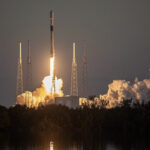
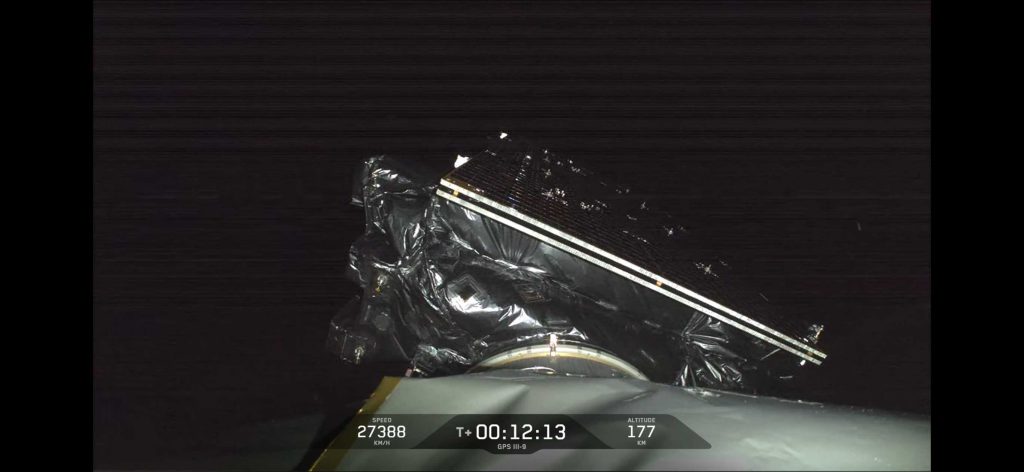
The U.S. Space Force launched GPS III Space Vehicle 09 (SV09) on a SpaceX Falcon 9 from Cape Canaveral Space Force Station, with liftoff of the GPS 3-9 mission from Space Launch Complex 40 occurring at 11:53 p.m. EST on Tuesday, January 27 (04:53 UTC on January 28), following a brief delay within the launch window. Public tracking now lists the satellite in medium Earth orbit as USA-574.
SV09 is the latest in the third generation of GPS satellites and carries modernized positioning, navigation and timing (PNT) capabilities, including the encrypted M-code signal for military users and the interoperable L1C signal for civil users. GPS III satellites are designed to provide up to three times better accuracy and as much as eight times improved anti-jamming performance compared with earlier GPS spacecraft, along with a design life of at least 15 years.
‘Ellison Onizuka’ and the Challenger anniversary
Consistent with the program’s practice of honoring explorers, SV09 is named for Col. Ellison Onizuka, a U.S. Air Force test pilot and NASA astronaut who flew on the STS-51C Space Shuttle Discovery mission in 1985 and later died in the Challenger accident on January 28, 1986. The naming ties this launch to the Challenger anniversary, which is being marked this week.
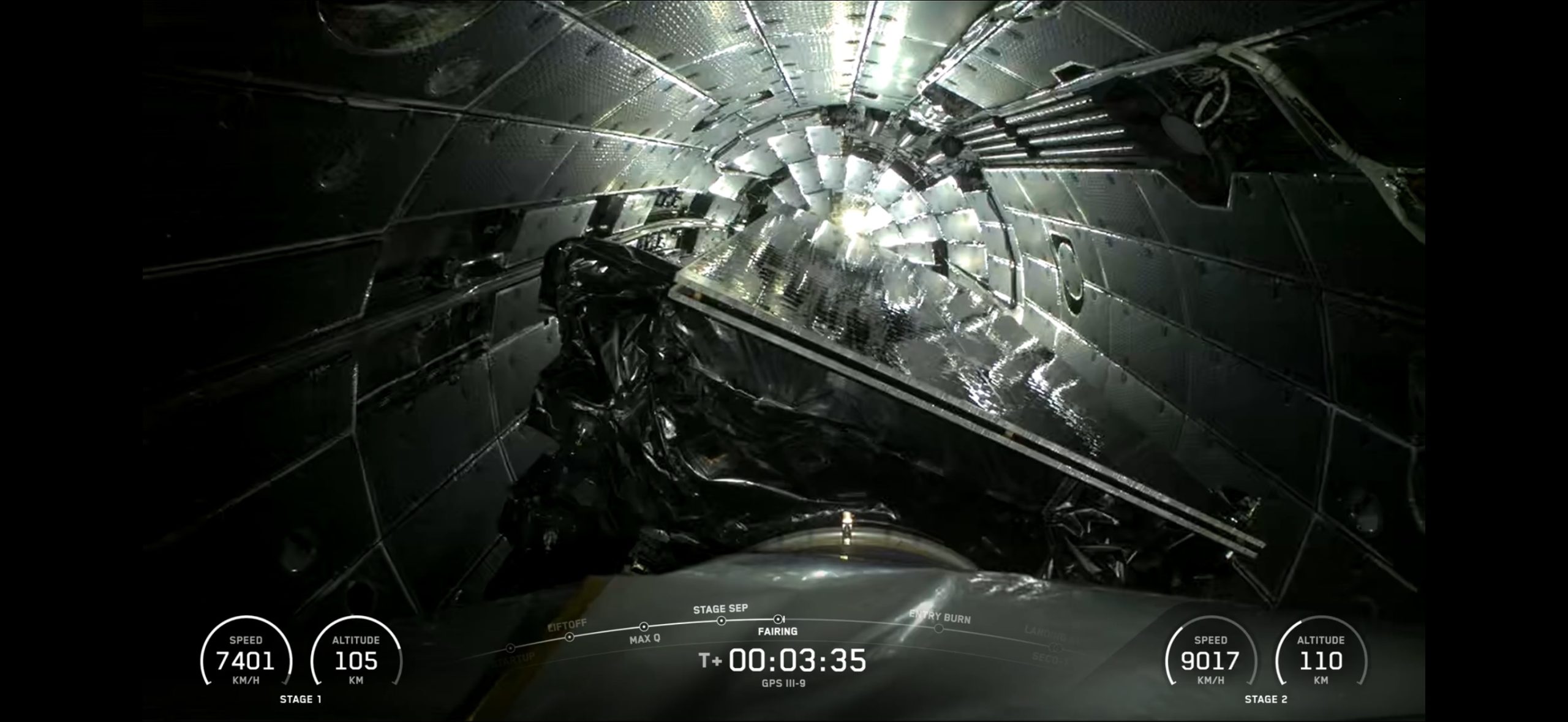
The spacecraft was built by Lockheed Martin on its A2100 bus and processed for launch at facilities on Florida’s Space Coast before encapsulation in Falcon 9’s payload fairing.
From Vulcan to Falcon 9
SV09’s path to orbit is also a case study in how the Space Force is managing its dual-provider NSSL manifest. GPS III-9 was originally assigned to fly on ULA’s Vulcan as part of the Phase 2 awards. Under the current plan, the mission was traded to SpaceX’s Falcon 9, with a later GPS IIIF mission reassigned in the opposite direction to keep the overall contract balance between providers.
“For this launch, we traded a GPS III mission from a Vulcan to a Falcon 9, then exchanged a later GPS IIIF mission from a Falcon Heavy to a Vulcan,” Col. Ryan Hiserote, commander of System Delta 80 (SYD 80) and NSSL program manager, said in a recent Space Force statement. “Our commitment to keeping things flexible – programmatically and contractually – means that we can pivot when necessary to changing circumstances.”
It is the latest in a series of GPS missions launched on Falcon 9 as the service leans on both providers to maintain constellation resilience and demonstrate more rapid response timelines for PNT assets.
Launch profile and booster reuse
GPS III SV09 flew a standard Falcon 9 profile to medium Earth orbit, with liftoff at 04:53:16 UTC and a northeast trajectory from Cape Canaveral. The mission was the 11th Falcon 9 flight of 2026 and the 594th Falcon 9 mission overall.
Falcon 9’s first stage, booster B1096 on its fifth flight, was slated to land on the autonomous droneship A Shortfall of Gravitas stationed in the Atlantic Ocean, continuing SpaceX’s practice of recovering hardware even on national security missions.
SpaceX planned spacecraft deployment into medium Earth orbit roughly 90 minutes after liftoff. Tracking and catalog data now identify the satellite as USA-574 in a semi-synchronous MEO slot, from which it will join the operational GPS constellation after on-orbit maneuvers and checkouts.
Incremental upgrades to the GPS constellation
GPS III SV09 joins a growing set of modernized satellites already in service, bringing additional M-code and L1C-capable assets into the operational mix. GPS III was conceived as the first stage of a broader GPS modernization effort that also includes GPS IIIF follow-on satellites and upgraded ground control segments. Together, those elements are intended to deliver more accurate PNT, stronger electronic protection and more robust civil interoperability for users worldwide.
Space Force officials have emphasized that each additional GPS III satellite enhances the overall robustness of the constellation, particularly for warfighters operating in jamming-intensive environments. “GPS III satellites, equipped with M-Code technology, provide the warfighter with a significantly more accurate and jam-resistant capability,” Space Systems Command noted in its announcement of the SV09 mission. “Adding another such satellite to the constellation enhances the system’s robustness and ultimately boosts the warfighting lethality of the Joint Force.”