At a recent event hosted by the European Space Agency (ESA), Artur Kobyłkiewicz, Project Manager at GMV Poland, and Roman Wawrzaszek, Project Manager at the Space Research Centre of the Polish Academy of Sciences (CBK PAN), presented the results of the GNSSWLEO project.
It highlighted an achievement marking a new level of European capability in space-qualified, software-defined navigation technology.
Over the past five years, GMV Poland has amassed extensive expertise in software-defined radio (SDR) receivers for space through the ESA-funded GNSSW and GNSSW-LEON4 feasibility and prototyping efforts.
GNSSWLEO, with GMV as prime contractor and CBK as subcontractor, delivers a dual-frequency, dual-constellation GNSS receiver designed for launcher and low Earth orbit (LEO) missions. The capability is essential for advanced precise orbit determination (POD) and formation-flying operations requiring centimeter-level accuracy, key enablers for future ESA and commercial missions including in-orbit servicing and debris removal.
Initially designed for the GOMX-5 platform, a CubeSat technology demonstrator developed by GomSpace for ESA, the new receiver has been adapted for in-orbit demonstration within Deimos’s Cassini IOD/IOV mission.
Demonstrated and qualified
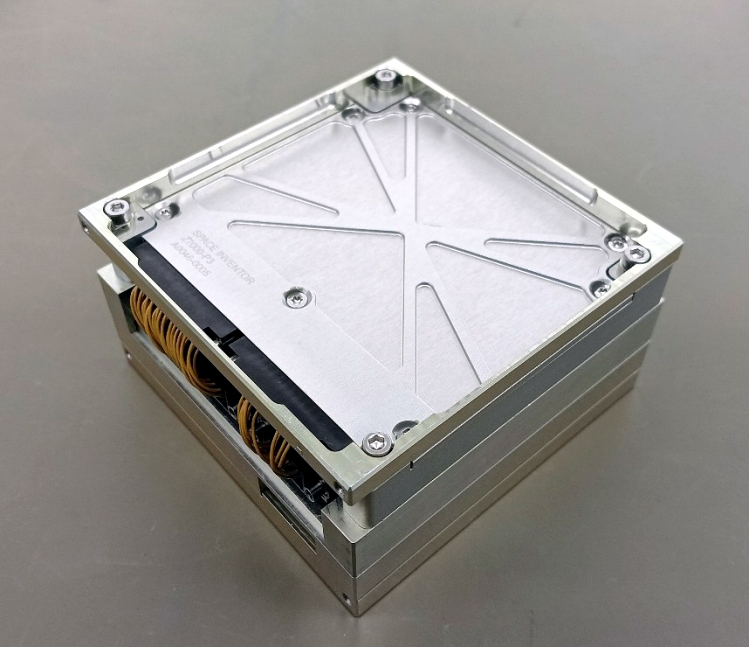
The final version, known as LEONE (LEO Navigation Experiment), integrates an internally developed RF front end and a Zynq-7030 processor board within a compact 0.5-unit form factor. The payload weighs about 470 grams, runs on 4 watts of power, and supports L1/E1 and L5/E5a signals via the Consultative Committee for Space Data Systems (CCSDS) packet utilization standard, over an RS-422 interface. Demonstrated performance included a less than 2.5 m rms position error and a less than 0.01 m/s rms velocity error in a 480 × 1200 km elliptical orbit.
Comprehensive environmental qualification, including thermal-vacuum, vibration, and EMC tests, was performed at ESA/ESTEC and CBK facilities. A redesign following early resonance findings improved mechanical robustness. Performance testing at the Warsaw University of Technology, using a Spirent GSS9000 simulator, validated nominal acquisition and tracking. After review with ESA, the system achieved Technology Readiness Level 7, with TRL 8 expected post-flight on Cassini.
GNSSWLEO responds to Europe’s growing need for autonomous, radiation-tolerant, reconfigurable GNSS receivers capable of precise, real-time orbit and timing solutions in LEO. Future developments, under ESA’s GMV-led NAVTIME-RX and SEXTANS LEO-PNT initiatives, will extend this technology to micro-launchers and advanced guidance, navigation and control systems.
GNSSWLEO is a clear step towards strengthening European autonomy and enabling precise, autonomous navigation for the next generation of small satellites and space missions. The project was funded under ESA’s NAVISP program, which supports European competitiveness in positioning, navigation, and timing (PNT) technologies.