It’s time to create a core architecture and re-establish U.S. global PNT leadership.
The Global Positioning System (GPS) was one of the most important innovations and contributors to the world’s prosperity in the last 80 years. It has been America’s gift to the world and reinforced the nation’s position as a technology leader.
Coming on the scene at about the same time as the microchip revolution, the positioning, navigation and timing (PNT) services provided by GPS have become an essential but invisible utility for virtually every infrastructure and technology. If imitation is the sincerest form of flattery, then the Soviet Union, the European Union and China paid America their highest compliments by building their own Global Navigation Satellite Systems (GNSS). Even today, almost 50 years after the first GPS satellite launch, nations and commercial entities are still exploring how they can create even more satellite PNT capability.
GPS was long a benchmark for all others. A goal to strive for. An important element of U.S. prestige, influence, hard and soft power. For years, it was rightfully described as the gold standard for satellite navigation systems.
While it is still called that by many, the reality has faded along with the nation’s commitment to GNSS leadership.
How it All Started
In “U.S. Policy Decisions that Shaped Civil and Commercial Use of GPS,” Brian Weeden provides an exceptional review of how national GPS policy has evolved over the years. Weeden said in 1995 the Clinton administration laid the foundation for GPS as the gold standard, though it was not immediately articulated that way.
That commitment to leadership and excellence may have been partly in response to Russia’s declaring their competing GNSS, GLONASS, operational in 1993. The GPS gold standard sound bite likely emerged as a way to reinforce America’s continued tech supremacy.
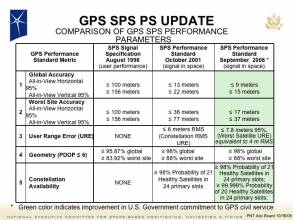
The phrase has certainly been well used. At government meetings, public forums like the National Space-based Positioning, Navigation and Timing Advisory Board and the Institute of Navigation, GPS advocates have relentlessly intoned the gold standard to describe the existing service, and as a metric against which to measure planned improvements, schedules and funding.
Yet, national policy has not always supported that standard, and the current reality is much different.
In his paper, Weeden observed that the gold standard approach was significantly modified in 2004 by National Security Presidential Directive (NSPD) 39, U.S. Space-Based Position, Navigation, and Timing Policy:
“The Bush GPS policy also made a small, but crucial change to the ‘gold standard’ concept. It established a goal to remain the preeminent military space based PNT service while continuing to provide civil services that exceed or are competitive with foreign civil space-based PNT…”
This policy was instituted when Europe’s civil GNSS project, Galileo, was in its fifth year of development. The Department of Defense, never keen on civil use of GPS, likely did not want the added burden of having to compete with a civil system for civil users. The policy officially put civilians squarely in second place behind the military.
Seventeen years later in January 2021, during the last days of the first Trump administration, the current national policy, Space Policy Directive 7, was issued. The term “preeminent” does not appear in it at all. Instead:
“The goal of this policy is to maintain United States leadership in the service provision, and responsible use of global navigation satellite systems, including GPS and foreign systems…”
Yet, even this toned-down goal seemed more wishful thinking or braggadocio. Well before the policy was issued, Europe’s Galileo (2016) and China’s BeiDou (2020) became operational and were more capable than GPS in many ways.
This was discussed later that same year with government leaders at a national advisory board meeting.
In 2023, the same advisory board bluntly told the administration:
“GPS’s capabilities are now substantially inferior to those of China’s BeiDou.”
Yet, GPS as “the gold standard” just won’t go away. As recently as May of last year, the Defense Science Board told the Department of Defense Undersecretary for Research and Engineering:
“The Global Positioning System (GPS) remains the gold standard in worldwide distribution of position and timing information, and precision…”
Time to Pivot
GPS is admittedly still a wonderful and amazing system. And U.S. Space Force continues its efforts to improve the constellation with projects like NTS-3 and R-GPS. Yet, even if Space Force receives the program and budget support it is seeking, these improvements are unlikely to restore GPS to global preeminence.
GPS is not now, and for the foreseeable future is not likely to be, the leading system. Constantly asserting otherwise is harmful in several ways.
First, it can deceive policy makers into believing “all is well” and the nation need not focus and continue to improve GPS and national PNT. This has adverse impacts on manpower levels, budgets, leadership focus, and program priorities. GPS devotees are actually harming the system’s future by heaping unwarranted praise.
Second, such ill-considered statements undermine the credibility of all who make them. Comparisons with Galileo and BeiDou make it very difficult to see GPS as the “preeminent” system, and national policy and budgeting don’t seem to be structured to change that.
Perhaps most harmful, though, is the overall approach of those who focus on the technology—GPS—and not upon its users.
GPS is a great system, but the only reason we have it is to provide users with the PNT they need. Very few users care where their PNT comes from. They just want it to always be there when they need it.
And while GPS satellites continue to operate flawlessly, interference with signals increasingly means users are not getting what they need. Such interference is going to continue and almost certainly worsen. Incentives for bad actors to jam and spoof are many, counter-incentives are few.
Making American PNT the Gold Standard
The idea of GPS as the gold standard has been with us for 30 years.
Perhaps it is time to set a new, user-focused goal and strive to make American PNT the gold standard. Resilient and assured PNT wherever and whenever needed.
Achieving such a goal will be far easier—and far less expensive—than it was to create gold standard GPS.
Combining GPS with one or two resilient technologies with different failure modes will create a resilient national core PNT architecture. One that will provide easily adoptable, utility-level, resilient service across the nation and its maritime approaches. It will also provide a framework into which other commercial and government entities can integrate their systems and build upon to serve a host of specialized PNT needs.
Candidate technologies are mature and available now as commercial services. The federal government should lead the way and let contracts to meet its many nationwide needs for resilient PNT, beginning with timing. Once contracts are let, the resilient timing component of the national core PNT architecture can be active within 18 months.
Creating a core architecture will also help re-establish U.S. global PNT leadership. American systems will be used by other nations to create their own sovereign PNT that works with and reaps the benefits of GPS. American business will profit from sales of systems and support. America’s standing in the world will also benefit as we support others’ tech independence and counter Chinese efforts to lure users away from GPS and toward BeiDou.
America is still a world leader. We should have, and achieve, lofty goals.
Making GPS the gold standard was a great goal and a great achievement. Thirty years on, it is time to refocus, just a bit, set a goal, and regain the global PNT leadership we have temporarily lost.