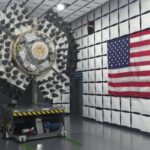
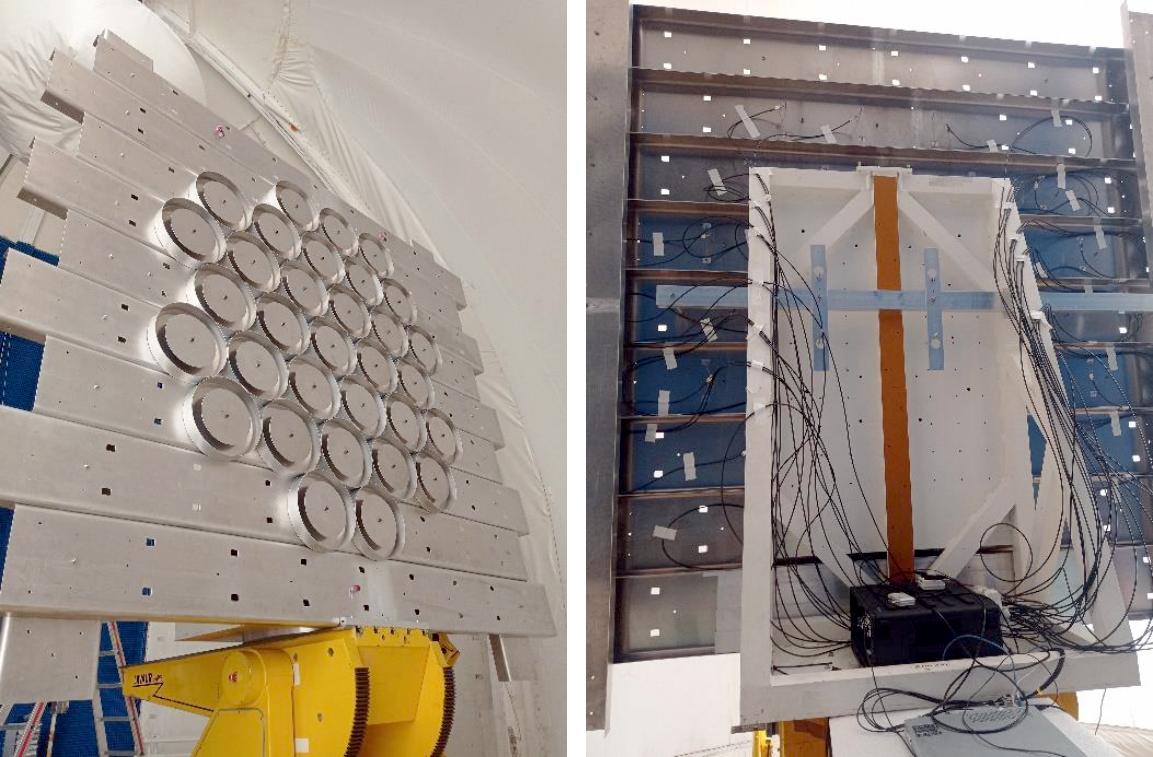
Thales Alenia Space, with funding from the European Space Agency (ESA) NAVISP program, has developed the ‘Advanced MEOSAR Test Beacon Setup’ (AMTBS).
This next-generation ground-based system introduces a 4×4 metre UHF digital beamforming antenna array capable of emulating moving search-and-rescue (SAR) beacons for Cospas-Sarsat MEOSAR (Medium Earth Orbit Search and Rescue) system testing.
Cospas-Sarsat is an international satellite-based SAR program that provides accurate, timely distress alerts and location data to relevant authorities. Since 1979, it has supported over 65,000 rescues worldwide. Originally reliant on LEOSAR and later complemented by GEOSAR, the system transitioned in the 2000s to MEOSAR, leveraging GNSS constellations to combine global coverage, low latency, and independent positioning.
The AMTBS project aimed to design, build, and validate a test beacon able to transmit tailored signals to individual MEOSAR satellites, mimicking the effects of beacon motion at varying speeds and trajectories. This enables rigorous evaluation of MEOLUT (Medium Earth Orbit Local User Terminal) performance under realistic movement scenarios.
MEOSAR’s integration on GNSS constellations offers global coverage, independent localization, and low latency, but performance degradation has been observed when tracking moving beacons, particularly at sea. By introducing per-satellite signal shaping, AMTBS enables accurate simulation of Doppler and timing variations without physically moving a transmitter.
Successful R&D campaign
The AMTBS system was subjected to an extensive end-to-end testing campaign. Broadcasts from the antenna array were received by operational MEOLUTs, which processed them as if they were signals from genuine moving beacons. Results demonstrated excellent alignment between generated and measured time-of-arrival (TOA) and frequency-of-arrival (FOA) values, confirming the fidelity of the simulation. Scenarios tested included velocities up to 400 m/s and accelerations up to 20 m/s², far exceeding typical operational needs.
Testing confirmed that AMTBS could replicate complex trajectories, linear, circular, and with abrupt accelerations, without impacting non-target satellites. The ability to inject other controlled variations, such as masking effects or intentional message errors, opens the door to broader system verification, including satellite sensitivity assessments and operational alert handling.
Independent verification of results aligned with Cospas-Sarsat expectations, though hardware integration improvements, such as adding a radome for weather protection and expanding to 64 antenna elements, are recommended to enhance usability and support future satellite growth.
Thibaud Calmettes, Design Authority at Thales Alenia Space, presented the final results at an ESA-hosted event, noting that AMTBS represents a breakthrough in MEOSAR test capabilities. The new system, he said, equips Cospas-Sarsat partners with a powerful tool for qualification, commissioning, and quality monitoring, enabling realistic, repeatable, and precisely controlled simulations of moving distress beacons.