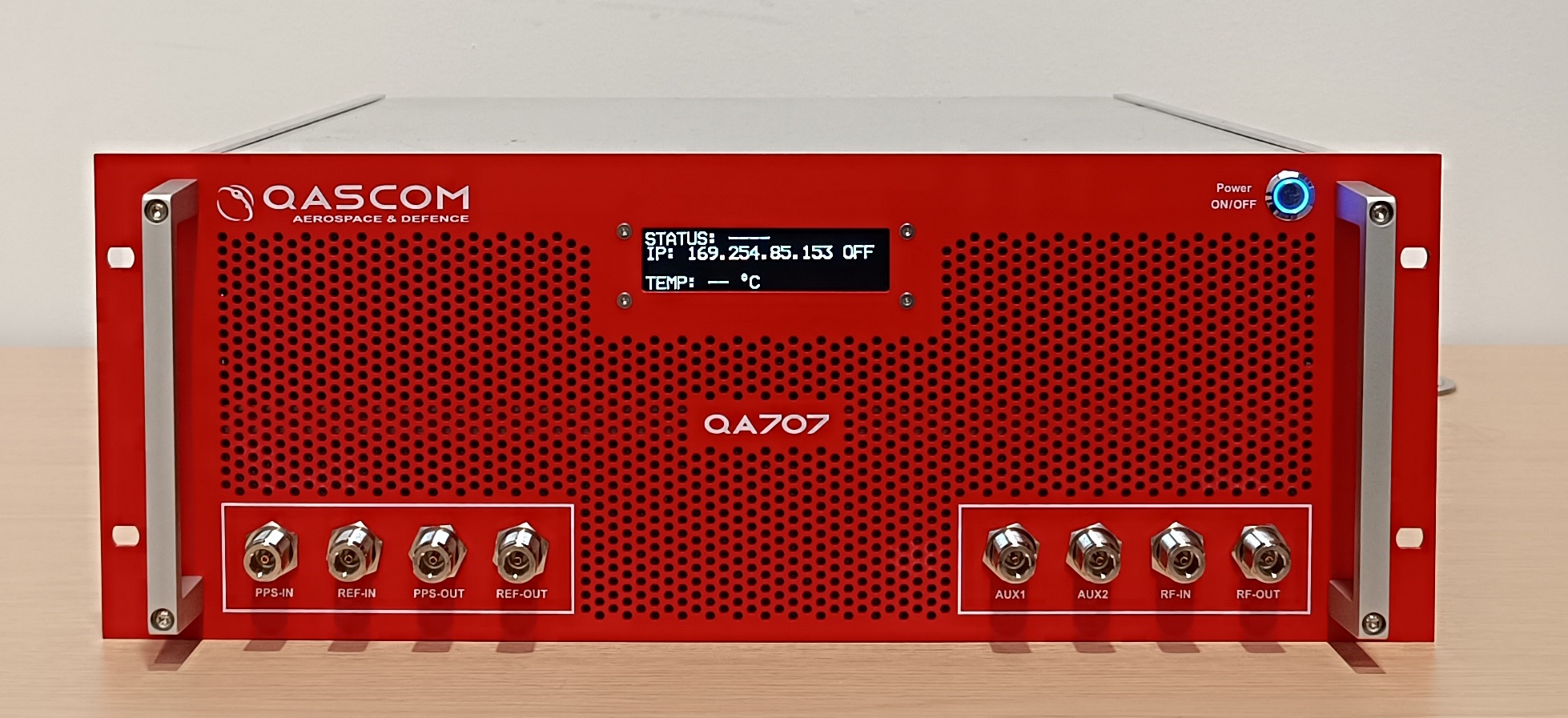
Financed under the European Space Agency (ESA) NAVSIP framework, the ‘Moon Testbed’ (MOOD) has developed Moon-enabled features for Qascom’s QA707 GNSS simulator, creating the first lunar GNSS testbed.
The device will be used in the development of lunar GNSS receivers, and to support studies and planning of diverse lunar missions.
The project was carried out by Italian aerospace and defense company Qascom, a familiar player in the European satellite navigation and security market, specialized in GNSS signal simulation, GNSS receivers, jamming and spoofing detection, and security technologies for Galileo.
At a recent event hosted by ESA, Marco Rotoloni, Qascom Simulators Technical Manager, delivered the MOOD final project presentation. “We wanted to develop a testbed for new PNT applications and technologies targeting space-scenarios, such as, but not limited to, satellites in lunar orbit and beacon stations on the Moon’s surface.”
The resulting Qascom GNSS QA707 v2.0.0 is essentially an upgrade of the QA707 v1.6.5. It is a fully software-based GNSS signal simulator, with performance similar to hardware-based simulators, that can be run on a laptop, enabling fast assessment of software- or hardware-based positioning, navigation and timing (PNT) technologies.
“With v1.6.5 we could simulate different forms of GNSS interference,” Rotoloni said, “allowing the testing of Earth-based GNSS authentication receiver schemes. With this new v2.0.0, the user can access all the features available in v1.6.5, plus the new features specifically targeting space scenarios.”
Full upgrade
New enhancements of the Qascom QA707GNSS simulator include:
- Support for additional coordinate reference systems (CRS) such as geocentric celestial reference frame (GCRF), Earth-centered inertial (ECI) and Moon-principal axis (Moon-PA), and conversion functions;
- Implementation of a ranging strategy for signals received on the Moon;
- Support for a transmitter visibility strategy based on line of sight (LoS) obscuration, instead of elevation masking;
- Support for an extended inertial measurement unit (IMU) emulator for space scenarios;
- Support for digital elevation model (DEM) data for signal obscuration and precise positioning;
- Support for the first interface control document (ICD) of LunaNet, the proposed lunar communications and navigation architecture led by NASA and supported by international partners; and
- Implementation of a 3D graphical interface for space and many other scenarios.
Rotoloni described an extensive and successful testing and verification campaign undertaken during the project. QA707 v2.0.0 has since been used in real tests of the DEMOS-1 lunar surface PNT beacon demonstrator, as well as other internal QASCOM projects. Rotoloni said the new system can also be used for Mars-related scenarios.
MOOD was co-funded under NAVISP Element 2, which aims to increase European competitiveness in PNT.