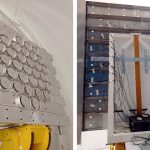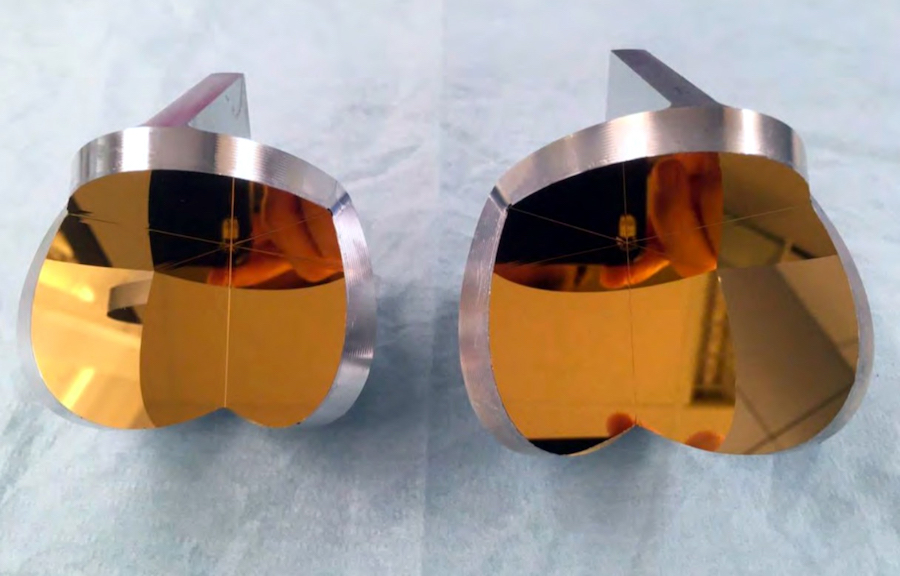
‘Hollow Corner Cube for In-Orbit PNT’ is an advanced optical reflector concept developed by the Istituto Nazionale di Fisica Nucleare (INFN) in Italy, with Media Lario s.r.l as subcontractor, under the European Space Agency (ESA) NAVISP Element 1 program.
The project aimed to design, manufacture, and test a hollow corner cube retroreflector (HCCR) suitable for spacecraft positioning, navigation and timing (PNT) applications, with a particular focus on reducing mass compared to conventional solid glass corner cubes while maintaining comparable performance.
HCCRs, which consist of three orthogonal flat mirrors, offer theoretical advantages in mass and optical precision, making them attractive for satellite and lunar laser ranging, as well as geodesy.
Simone Dell’Agnello, Executive Technologist at INFN delivered the project final presentation of the project at a recent ESA-funded event. During development, he explained, the team employed the Repli-forming manufacturing method, which showed potential for faster production, reduced costs, and improved angular precision.
Tried and tested
The HCCRs underwent a dedicated environmental test campaign, assessing mechanical stability and optical performance under simulated space conditions. Tests confirmed that while the devices suffered no mechanical damage, their optical performance was highly sensitive to the torque applied at the mounting interface.
Nominal optical quality required only 0.3 Nm torque, whereas higher torque levels degraded performance. This finding pointed to the need for mechanical design modifications to improve stability without stressing the mirrors.
Independent metrological validation by the INRIM metrology institute confirmed the device’s angular accuracy, although further prototype iterations were recommended before operational use. The study also highlighted that achieving larger HCCR diameters, necessary for applications such as Earth-Moon distance measurements, remains a technical challenge. Current prototypes reached 2.8 inches, short of the required 4 inches.
Dell’Agnello concluded that while the lunar thermal environment is beyond the current capability of the Repli-forming approach, HCCRs could be viable for less demanding space missions. Prospects for further development include refining the mechanical interface, exploring multiple manufacturing techniques, and conducting more rigorous space qualification tests on both custom and commercial HCCRs.
The results of the ‘Hollow Corner Cube for In-Orbit PNT’ project, Dell’Agnello said, mark a step forward in the quest for lighter, high-performance optical retroreflectors for future space exploration and scientific applications.