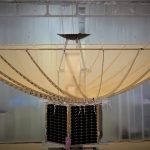
Funded under the European Space Agency’s NAVISP program, the ‘Deployable Satellite Navigation Antenna’ project has delivered a compact Ka-band antenna prototype for small satellite platforms.
Partners, led by Finnish company Huld Oy, with contributors Radientum Oy and the Finnish Meteorological Institute (FMI),wanted to demonstrate that a high-performance satellite navigation antenna can be stowed for launch and reliably deployed in orbit. Project results were presented at a recent ESA-hosted event by Juho Veteläinen and Jaakko Kaartinen of Huld and Mikko Kärnä Leino of Radientum.
The rapid growth of small satellites and mega-constellations in low Earth orbit is driving demand for improved navigation accuracy, signal availability and resilience. While Ka-band offers clear benefits for precision navigation, its use on small satellites remains limited due to constraints on antenna size, mass, and deployment reliability.
The project began with a review of state-of-the-art deployable antennas and spacecraft navigation needs. Two mission concepts were identified to anchor the design: in-orbit servicing missions, including refueling, repairs, and debris removal, and low-lunar-orbit navigation to support exploration and infrastructure development around the Moon.
Informed choices
Partners conducted a detailed assessment of three deployable antenna concepts: a stacked patch antenna, a metallic horn fed by a patch, and a lens-based solution. Electrical and mechanical performance were evaluated using criteria derived from ESA requirements.
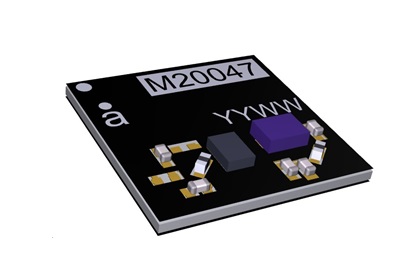
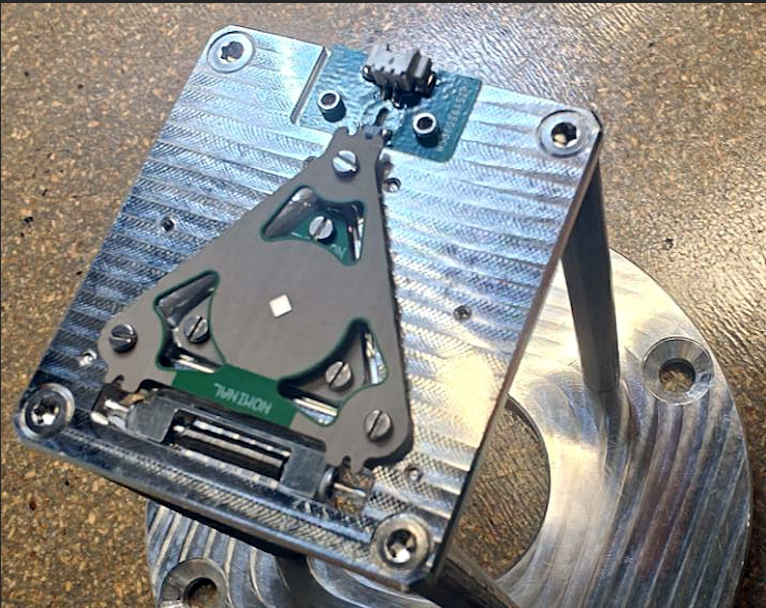
The deployable stacked patch antenna emerged as the most promising option. The final configuration combines a feeding patch PCB with integrated RF components and two parasitic stacked patches that shape the radiation pattern and enable dual circular polarization in the 35 GHz Ka-band.
Manufacturing and testing were carried out in several iterations to reduce technical risk. Mechanical testing verified repeated stowage and deployment, low mass, and high dynamic stability. The breadboard weighed only a few tens of grams and achieved natural frequencies far above minimum requirements for CubeSat-class platforms.
Electrical testing was first performed at Aalto University and later at ESA ESTEC. Measurements showed good agreement with simulations. Additional wave traps were introduced to suppress surface waves and widen the antenna beam. As a result, most electrical requirements, including bandwidth, return loss, phase stability, and group delay were successfully met.
Veteläinen said the results show that compact, deployable Ka-band navigation antennas are a viable enabling technology for next-generation small satellite and lunar missions. Future options include preparing the deployable design for flight, developing a fixed low-cost variant, or scaling the concept to other frequency bands.