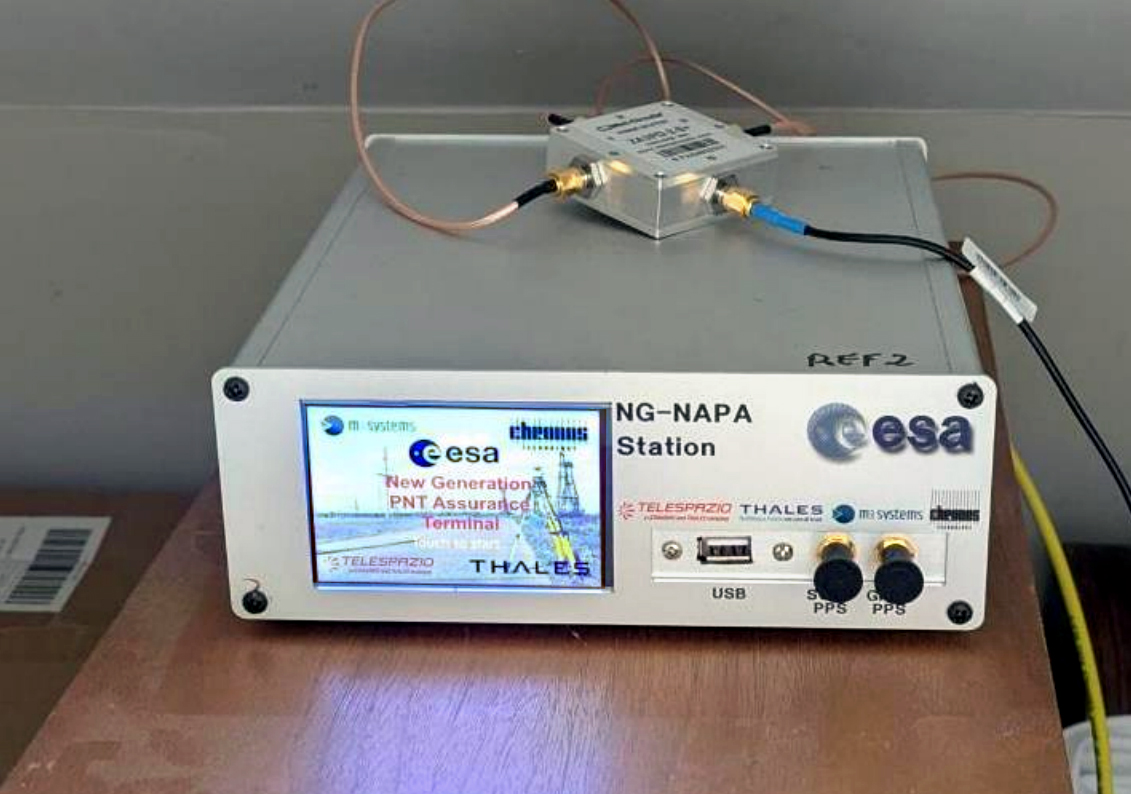
Funded by the European Space Agency (ESA) NAVISP program, the NG-NAPA project, led by Telespazio UK, with support from Thales Services Numériques, M3 Systems, and Chronos Technology, has taken a new step forward in resilient, flexible, and secure positioning, navigation, and timing (PNT).
A hybrid architecture developed by the project combines GNSS with signals of opportunity (SOOP), including 5G, LTE, and Iridium satellite signals. By exploiting these alternative signals, the system ensures positioning and timing continuity even when GNSS signals are degraded or manipulated.
Key innovations include authentication of GNSS and SOOP signals, secure time transfer, hybridization techniques to merge multiple data sources, and a network architecture designed to reduce latencies and improve resilience.
Telespazio UK and partners explored several cutting-edge methods. Among them were GNSS time authentication using ‘common view’ techniques, position authentication based on time difference of arrival (TDOA), and the use of Iridium satellite signals for positioning in weak-signal environments.
Challenges included how to identify signals in crowded frequency bands (e.g., Starlink constellations), mitigating radar interference on Galileo’s E6 band, and ensuring synchronization across reference and user stations connected via cloud infrastructure.
Extensive testing campaign
At a recent ESA-hosted event, representatives of the project partners, led by Telespazio UK’s Louise Mercy, delivered the final project presentation.
To demonstrate the new system, Mercy said, the team deployed reference and user stations across Europe, supported by high-precision Caesium clocks and cloud-based processing. The test campaign involved real-world signal capture under both static and dynamic conditions.
Timing trials using Iridium signals showed the system is resilient to GNSS jamming, achieving accuracy within 2 microseconds 95% of the time, although availability was sometimes an issue. Positioning trials using GPS and Galileo showed encrypted signals can enhance spoofing protection. Challenges remain with high outlier rates and sensitivity to interference.
Overall, the results validated the NG-NAPA concept while highlighting areas for improvement, such as oscillator stability, processing efficiency, and data handling.
The main take-aways are clear: the feasibility of the new solution was confirmed; hybridizing GNSS with SOOP signals significantly enhances resilience against spoofing and jamming; while further work is needed to refine hardware, improve timing stability, and streamline cloud-to-user processing.
Partners said the project establishes a robust foundation for future PNT assurance systems that could serve critical industries, transport, and national infrastructure. Next steps include integrating these innovations into commercially viable assurance products, strengthening hardware platforms, and expanding the system’s applicability to real-world markets.